Articles are currently available in English.
Exercise
Rainy-Day Indoor Walking: A Plan for a Small Room
By Sweat & Snack Editorial Team · 2026-10-10
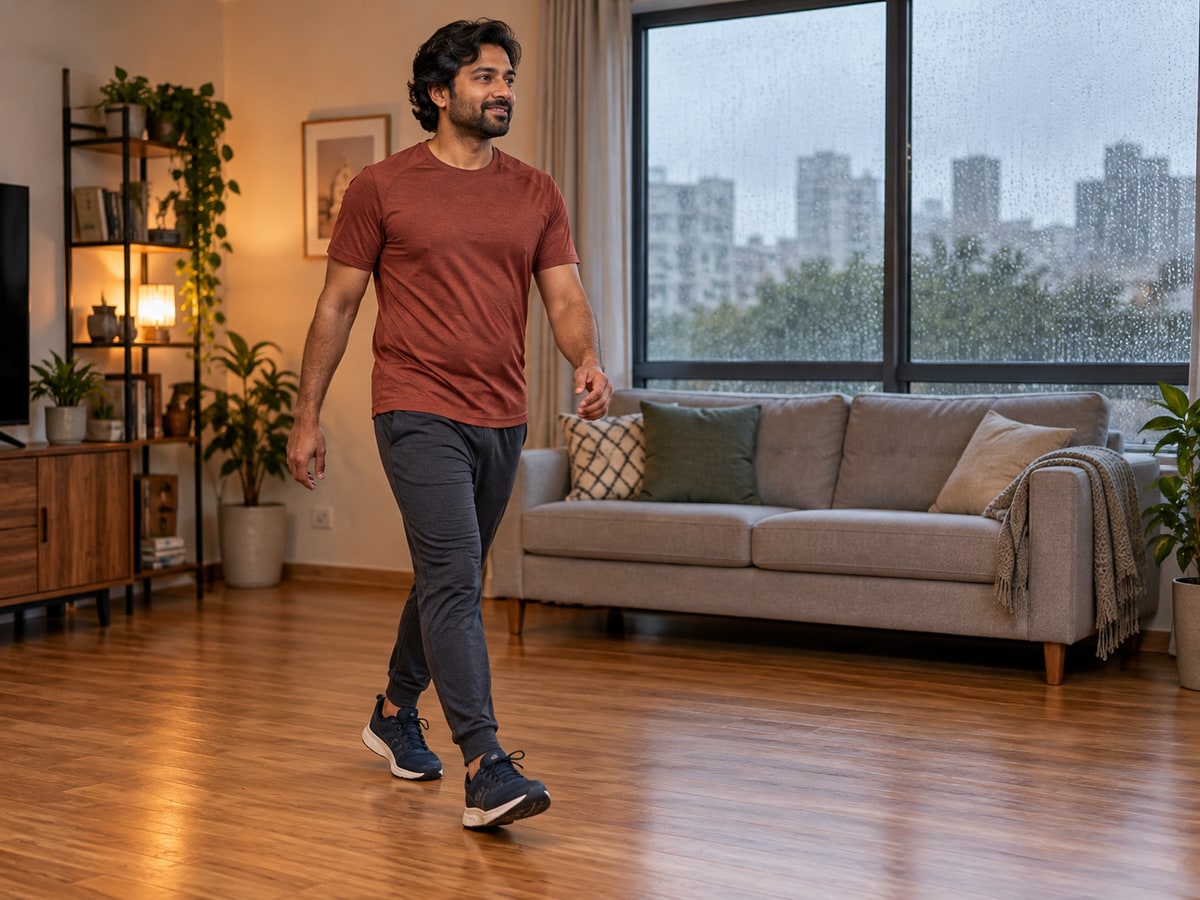
Rain cancelled your usual walk, and there is no treadmill at home. If you have a clear, dry space where you can move comfortably, you can plan a short indoor walk using a simple route or walking on the spot. Start with the space you actually have, choose a manageable pace, and leave step targets out of the first attempt.
This guide answers a practical question: how do you organise an indoor walking break in one small room, including the turns, interruptions and limited floor space? The route choices and ten-minute outline below are original suggestions to adapt. They are not a personalised exercise prescription or a promise that a room walk matches a particular outdoor distance.
Choose your route before starting the timer
As a setup suggestion, move loose cables, bags and small objects away from your feet. Choose a dry floor and leave enough room to move without brushing furniture. Keep doorways clear for other people. The NHS walking guide recommends comfortable, supportive shoes; use footwear that suits your floor rather than assuming socks will work on every surface.
A clear room or corridor
Try the route once at an unhurried pace. Choose a turning point before you reach a wall or piece of furniture, and give yourself room to turn without rushing. Avoid designing a loop around sharp table corners or squeezing through a gap. If the route feels awkward at a slow pace, change it before adding a timer.
Only a small patch of floor
Walking on the spot is a practical alternative to repeated room-length trips. Keep the movement comfortable rather than turning it into a high-knee challenge. You can alternate a little walking on the spot with a clear route if you prefer. The choice is about what fits your room, not which option looks most impressive on a video.
No suitable space today
Skip this setup if the floor is wet, cluttered or shared in a way that makes movement awkward. An accessible indoor corridor or other permitted walking space may be more convenient. You can also move the walk to another time. There is no need to add stairs, jumping or a new piece of equipment just to make this particular plan happen.
A flexible ten-minute indoor walking outline
These times are an organisational example, not a minimum dose or a target everyone needs to finish. Shorten the outline, pause, or stop whenever appropriate. If you are returning to activity or have questions about what suits you, ask a qualified professional for individual guidance.
- First two minutes: walk comfortably while checking the route. Notice whether turns, footwear or nearby furniture need attention. Keep the timer somewhere you can see without holding it.
- Next six minutes: continue at a pace that feels manageable. Use your route, walk on the spot, or alternate the two. Slow down for turns instead of racing to keep the same rhythm.
- Final two minutes: return to an easy pace, finish, and note what worked. If you ended earlier, record the time you actually walked.
For example, you might write: “Short room route, paused when someone crossed the room, then walked on the spot.” That tells you more about the next attempt than a step count alone. Keep the note brief enough that you will use it.
Does indoor walking count as exercise?
Location alone does not tell you the intensity. The CDC describes the talk test as a rule of thumb: during moderate-intensity aerobic activity, a person can talk but cannot sing. Effort varies between people. Do not label every minute of a slow indoor stroll as moderate activity simply because a timer is running.
You do not need to force a faster pace in a room that is too small for it. Use the available space comfortably and choose another setting if you want a different session. This plan makes no calorie estimate, guaranteed step total or claim of equivalence to a treadmill workout.
Handle interruptions and shared-space noise
As a household planning suggestion, choose a time when the route is least busy and tell others where you will be walking. Pause when a child, pet or housemate enters the path. Keep headphones low enough to remain aware of the room, or leave audio off for the first attempt.
Walking without jumps may suit your preferred routine, but no indoor workout is guaranteed silent. If footsteps carry to another room or flat, agree a convenient time or choose another space. Avoid adding a loose rug to the route just to quiet the session.
Fit the break into your wider week
CDC adult guidance recommends at least 150 minutes of moderate-intensity aerobic activity per week, or an equivalent vigorous combination, plus muscle-strengthening activity on at least two days. Activity can be spread across the week in smaller chunks. This single indoor break does not cover the whole recommendation.
Our weekly activity guide explains the broader context. Pair your walking plans with a separate strength-training plan where suitable, and use the planner to reserve realistic times. If your immediate problem is a break between desk tasks, the desk mobility guide covers a different option.
Before repeating or extending it
Review the room first: was the route clear, were the turns comfortable, and did the timing fit your day? Change one practical detail next time, such as the route or time of day. The NHS advises people who are not very active but can walk to increase walking distance gradually. Seek guidance if you are unsure how that applies to you. Stop the session if you feel unwell rather than treating the timer as an obligation.
Sources and image notes
Walking guidance from the NHS, and CDC intensity and adult activity guidance, were checked on 10 October 2026. Room organisation, route choices and timing are original practical suggestions. Feature and Pinterest images are AI-generated photographic illustrations of a fictional adult walking indoors.