Articles are currently available in English.
Exercise
Your First Dumbbell Weight: Choose for the Exercise
By Sweat & Snack Editorial Team · 2026-10-16
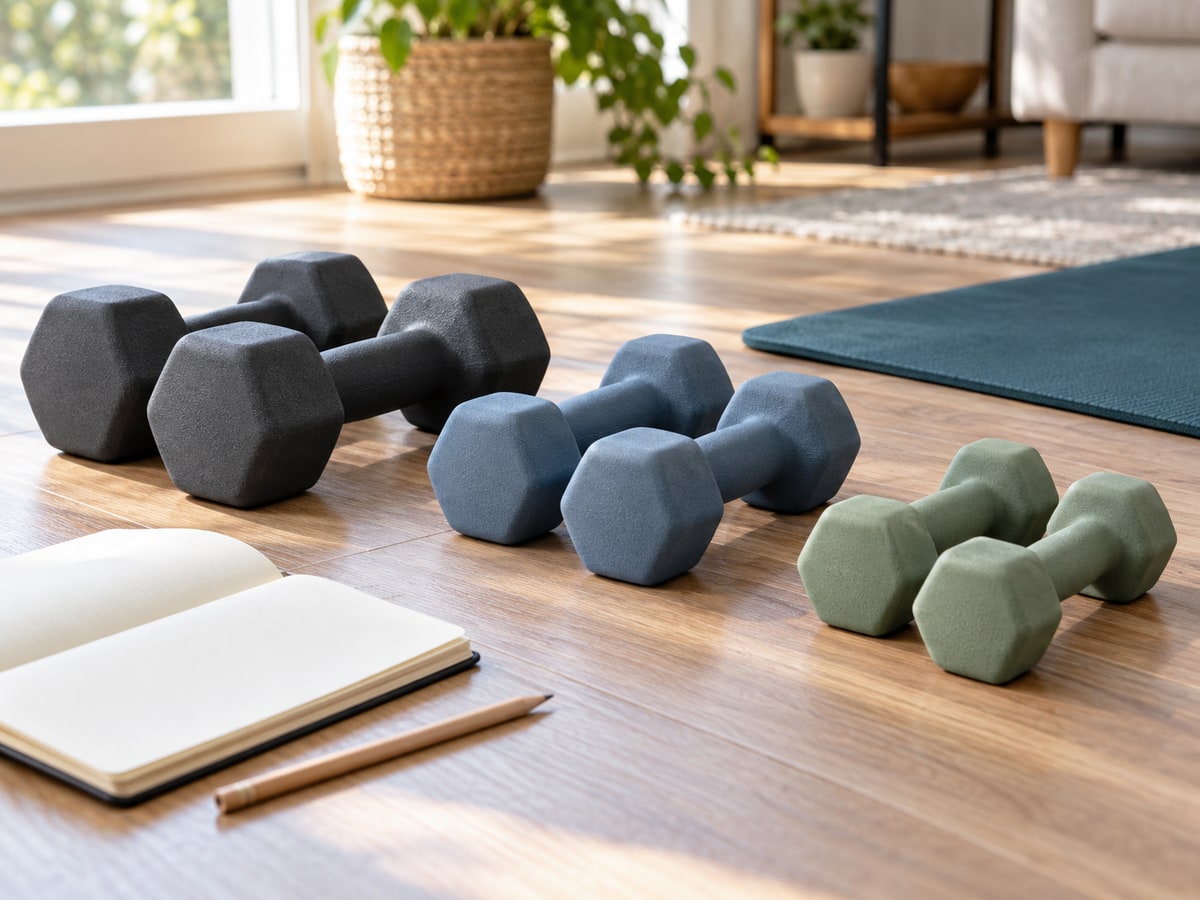
Choose your first dumbbell weight for the exercise you are learning, rather than starting with a number copied from someone else's workout. Begin with a load you can control, learn the movement, and ask a qualified fitness professional for help if you cannot judge your technique. You do not need to buy a whole rack before having that conversation.
This guide offers a practical way to organise that first choice and record what happens. It is not an individual training prescription or a test that certifies a weight as safe. If you have an injury, health condition or instructions from a clinician, use advice tailored to you.
Start with the exercise, then consider the weight
Write down the movement you intend to practise before shopping. A workout video that says to use light dumbbells still leaves a question: light for which exercise, and for whom? Ask the instructor what a suitable beginner option looks like for that particular movement. A description such as beginner-friendly does not tell you which kilogram marking to choose.
For your first conversation with a trainer, you could take three details: the exercise name, the equipment you already have, and what you find difficult when trying the movement without an added load. That gives you a specific starting point instead of a request for the best weight for all beginners.
Check whether the label means one dumbbell or the pair
When browsing a set, check the product description. Record the weight of each dumbbell, how many are supplied, and the available increments. A pair and a single dumbbell are different purchases. If a seller's wording is unclear, ask before ordering rather than assuming the largest printed number describes one hand weight.
Learn the movement before turning it into a challenge
For someone just starting, Mayo Clinic recommends learning proper technique with a fitness specialist. Its general guidance suggests beginning with a weight that can be lifted comfortably for 12–15 repetitions, reducing the load or repetitions when form cannot be maintained, and stopping an exercise that causes pain. That range is a reference for a discussion, not a quota you must reach despite difficulty.
Use the instructions for the specific exercise, including how to pick up and put down the equipment. If you are unsure what correct movement should look like, get that clarified before using repetition count to decide whether a weight suits you. Counting alone cannot check your technique.
Write down what ended the practice
As an organising suggestion, describe what you noticed in ordinary words. Did you lose track of the instructions? Did you need to hurry to match a video? Was holding the equipment awkward? Did the movement cause pain? These observations are more useful to an instructor than simply writing that the weight was bad.
Do not keep repeating an uncomfortable movement to gather more information. Stop if it causes pain and seek individual advice where needed. For a simpler starting option, the NHS strength-exercise page includes movements using light hand weights or filled water bottles. Follow the exercise's own instructions; substituting an object does not remove the need to learn the movement.
Keep a small record instead of changing everything
Try a notebook entry with these fields: exercise, weight per dumbbell, repetitions completed, and one short observation. Leave a space for the trainer's advice. You can add a date if it helps you compare sessions later.
- Exercise: use the same name as the lesson or instructor.
- Equipment: note the weight of one dumbbell, not just the set's total.
- What happened: describe control, instructions or another difficulty without guessing its cause.
- Next question: write what you want the instructor to check.
There is no need to turn the record into a score. The point is to make the next decision easier. Our rest-between-sets guide covers a separate part of a home session; equipment choice does not decide your rest period by itself.
If you only own one pair
Tell the instructor exactly what you have. You could ask which exercises fit that equipment, which are better practised without it, and whether a different starting routine would be more suitable. Avoid building a whole workout around using the same purchase in every movement just because it is available.
If you have not bought anything yet, consider trying equipment with an instructor before making a larger purchase. If you choose an adjustable set, read the maker's assembly and locking instructions. Check the available space for setting it down and storing it; keep loose equipment out of walkways.
When is it time to change the load?
Mayo Clinic advises increasing weight gradually as you become stronger while maintaining correct technique. Ask the person guiding your training what progression should look like in your programme. Do not set an automatic weekly increase based only on the calendar.
You can keep the broader plan manageable too. See our guide to including muscle-strengthening in your week, or the missed-workout planning guide when a session has to move. A clear next session is more useful than buying equipment to compensate for a busy week.
Sources
Mayo Clinic: Weight training — Do's and don'ts of proper technique
NHS: Strength exercises