Articles are currently available in English.
Exercise
How Long Should You Rest Between Sets at Home?
By Sweat & Snack Editorial Team · 2026-10-12
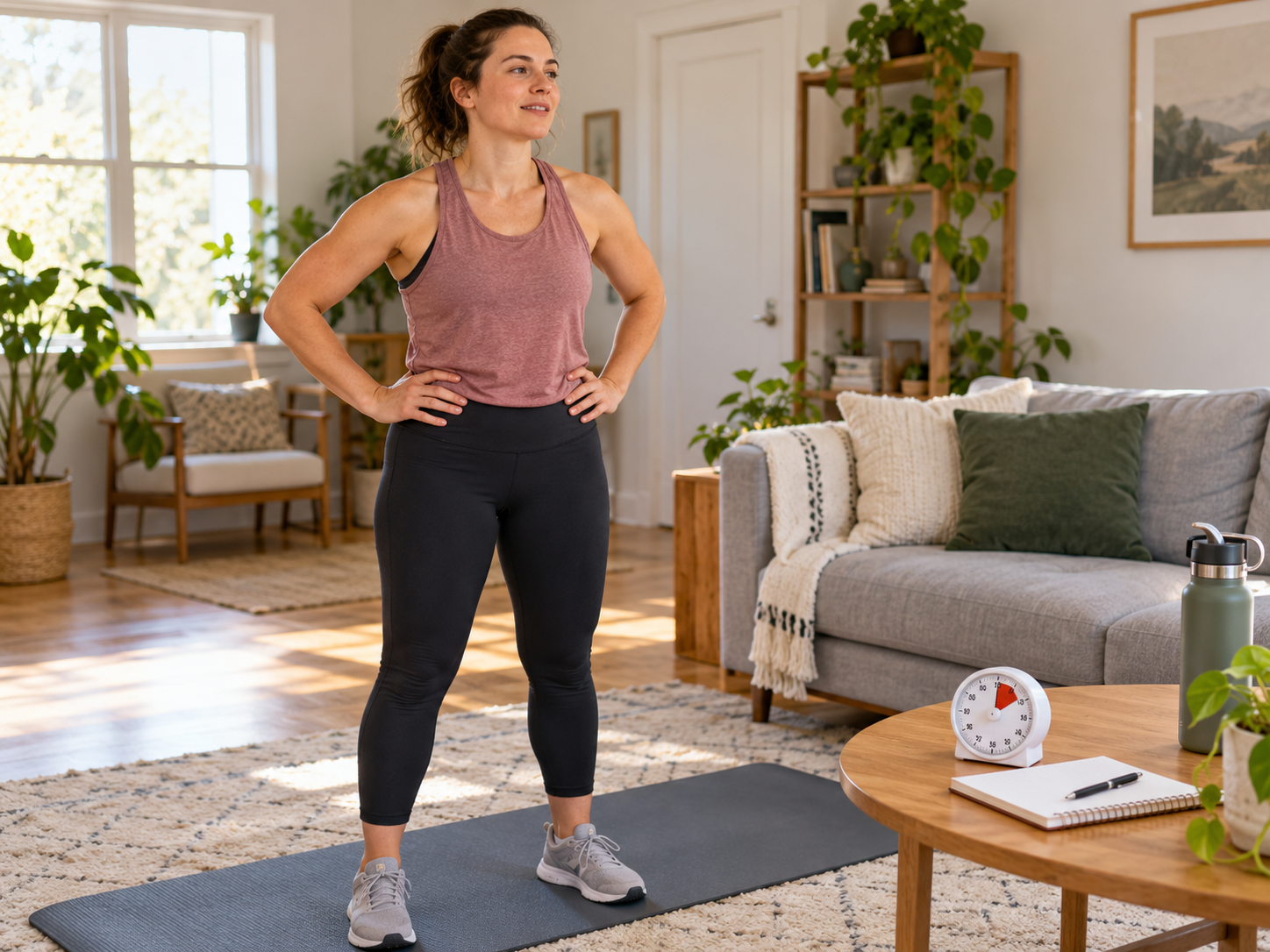
At home, the best break between sets is often the break that lets you do the next set with steady attention and a shape you can control. You do not need a stopwatch rule copied from someone else’s gym plan. Use the movement, your breathing and the quality of the next repetition to decide whether to start again or take a little longer.
This guide answers a small but common home-workout question: when am I ready for the next set? It is a planning guide, not a promise about strength, muscle gain, calories or recovery. If you are learning a new movement, an instructor can help you choose a starting version before you decide how quickly to repeat it.
Begin with the session you actually have
A set of slow wall push-ups, a challenging squat variation and a short band exercise may ask different things of you. There is no single pause that makes all three feel the same. Rather than choosing a number before you begin, make room to notice how the first set went.
As a practical suggestion, keep the first home session simple: choose one or two familiar movements, use a stable surface and stop each set before technique becomes rushed. Our wall push-up guide is one example of a movement to learn carefully; the indoor walking guide offers a different option for a low-equipment day.
Use a readiness check instead of chasing a perfect number
Before the next set, ask three plain questions. Can you breathe comfortably? Do you understand the next repetition? Can you keep the same controlled setup? If the answer is yes, you might start again. If one answer is no, give yourself more time.
- Breathing: let it settle enough that you can pay attention to the movement instead of rushing through it.
- Setup: reset your feet, hands, chair or band rather than starting from an awkward position.
- Control: choose a pause long enough that you are not relying on momentum to get through the first few repetitions.
These are suggestions for ordinary home practice. They are not a test of fitness and they do not replace individual guidance for pain, dizziness or other symptoms.
Three ways to use the pause
Use a short pause for an easy familiar movement
If the movement feels easy and you can still set up carefully, a brief drink of water, a few normal breaths and a quick reset may be enough. There is no need to lengthen a pause simply because another programme does. Keep the next set easy enough to stay controlled.
Take more time after a demanding set
When a set leaves you noticeably breathless or your form starts to change, take more time. Walk slowly around the room, note how the last repetition felt and begin only when you can return to the same setup. A longer pause is not wasted time; it is part of a session you can repeat with attention.
Stop the set sequence when the plan no longer fits
Sometimes the useful choice is to stop rather than force another set. End or change the session if the floor is slippery, you cannot keep stable footing, you are too tired to understand the movement, or something feels painful or unwell. Do not use a timer to push past a warning sign.
A simple at-home note can be more useful than an app
Try a small log for one week: write the movement, how many sets you attempted and whether the next set felt controlled, rushed or too difficult. Next time, change only one thing. You could rest a little longer, reduce the number of repetitions or choose an easier version. This is an original planning method, not a medical or training prescription.
Use the weekly planner to reserve a realistic time window rather than trying to make every session longer. A short, familiar session can be enough to practise the routine of setting up, pausing and stopping when needed.
When to get individual help
Ask a qualified fitness professional about technique and progression if you are unsure how to perform a movement. Stop and seek appropriate individual advice for pain, dizziness, chest discomfort or symptoms that concern you. An online rest guide cannot determine whether a particular exercise is suitable for you.
Sources
- American College of Sports Medicine: Complete Guide to Fitness & Health
- ACE-supported research on rest between sets
General educational information. The readiness check, log and examples are Sweat & Snack suggestions; they are not personalised coaching or medical advice. The feature and Pin images are AI-generated illustrations of a fictional home workout.