Articles are currently available in English.
Nutrition
Pumpkin Seeds: Whole or Shelled for Your Next Meal?
By Sweat & Snack · 2026-10-29
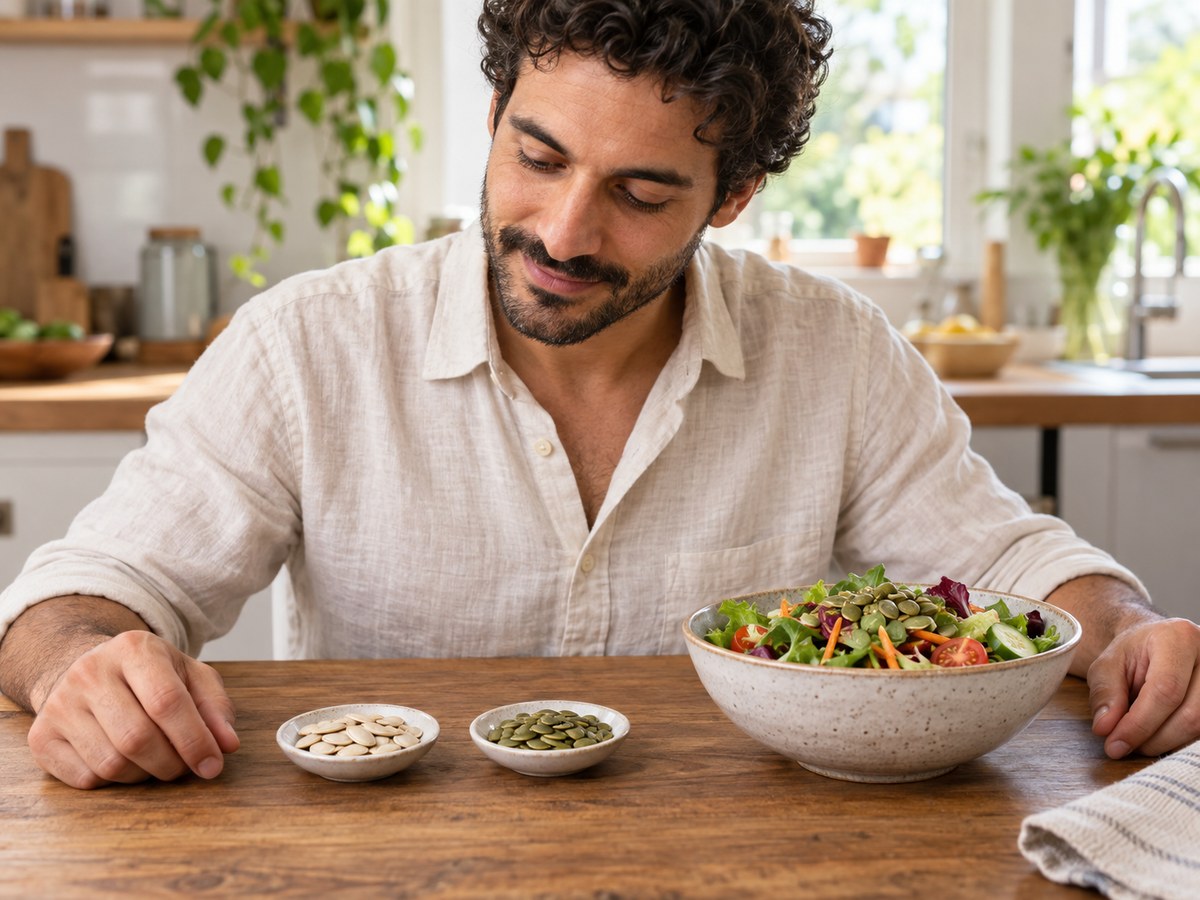
For a salad topping, green pumpkin-seed kernels are usually the straightforward choice. A bag of pale seeds with the shell still on is a different eating experience. Before swapping one for the other, check what is actually in the packet, whether it is ready to eat, and which form your meal needs.
This is a shopping and serving guide, rather than another pumpkin recipe or a list of promised benefits. It answers a small question that matters when a recipe says “pepitas” but the shop shelf offers several kinds of pumpkin seeds.
About the photograph: the small saucers compare seed forms; they are not a suggested serving. The salad shows one way to use kernels as a topping. Choose an amount that fits your meal and dietary needs rather than copying a photograph.
Start with the seed, not the name
Whole pumpkin seeds commonly have a pale outer shell around the inner kernel. Green kernels are sold without that hard white casing. Naming varies between sellers: a packet may say kernels, shelled seeds, hulled seeds or pepitas. Read the description and look through the packet where possible rather than relying on the front name alone.
Iowa State University Extension, in guidance reviewed in March 2026, explains that pepitas can come from pumpkin varieties with shell-free seeds. They are tender and greenish. That is why buying green pepitas need not mean somebody has mechanically peeled ordinary white seeds.
Match the form to what you want to eat
| Your plan | Useful starting choice | Check before buying |
|---|---|---|
| Scatter over a salad or yogurt | Green kernels | Ready-to-eat directions and seasoning |
| Follow a recipe specifying pepitas | The specified green seed form | Whether the recipe calls for raw or roasted kernels |
| Enjoy shell-on seeds as their own snack | A product sold for that use | Eating instructions and whether the texture suits you |
| Use seeds scooped from a pumpkin | A separate preparation project | A reliable cleaning, drying and roasting method |
These are practical kitchen choices, not a ranking of which form everybody should eat. A tender kernel and a shell-on seed are not interchangeable textures. For a topping, start with a small amount and see whether it works with the food underneath. Do not assume every packet is ready for immediate eating; follow its directions.
Compare the actual label
The FDA label guide explains that nutrient figures refer to the stated serving and that a serving size is not an instruction about how much to eat. For a useful comparison, line up the serving amounts and the form being described. Check sodium and added sugar as well as the ingredient list; plain and heavily seasoned products answer different preferences.
For example, if one packet lists a 20 g serving and another lists 30 g, the printed nutrient figures do not describe the same amount. Compare like amounts using the pack information where available. If you discard shells, do not assume a shell-on weight describes the same quantity of eaten kernels. Ask the manufacturer if its label basis is unclear.
Nutrient values vary by variety, brand, serving size and preparation. This guide deliberately gives no universal protein, magnesium or fibre number for a spoonful. Our fibre-label guide covers the broader label-reading process; the extra question here is whether you are comparing the same seed form.
Use one packet in different meals
Try ready-to-eat green kernels as an optional finishing ingredient rather than building every meal around them. The following combinations are serving suggestions, not tested recipes or nutrition prescriptions.
- Cool-weather bowl: add a little crunch to a warm vegetable soup just before eating.
- Warm-weather lunch: scatter over a leafy salad with whichever vegetables are locally available.
- Breakfast: put a small spoonful beside oats or yogurt, then add it at the table.
- A packed meal: carry the dry topping separately so you can choose the texture at lunch.
The existing savoury yogurt and chickpea bowl already uses separate dry toppings. Here the decision comes earlier, at the shop: choose the kernel form that fits that topping role. You do not need to replace a meal's other ingredients or treat seeds as a required addition.
Season and location change the shopping choice
If local shops are full of autumn pumpkins, saving their seeds may be an appealing separate cooking task. In another climate or season, a clearly labelled packet may be the more practical option. This article does not claim fresh pumpkins are seasonal everywhere in October. Northern autumn and Southern spring can suggest different meals, but local availability matters more than a hemisphere label.
A soup topping and a fresh salad topping can use the same packet of green kernels. Choose the surrounding vegetables for your location and weather. If the seeds are unavailable, omit the topping or use another ingredient that fits the recipe and your dietary needs; the dish does not need a “superfood” replacement.
Keep preparation and storage instructions separate
Seeds just scooped from a pumpkin are not the same product as a sealed ready-to-eat packet. Follow a reliable preservation or cooking method for fresh seeds rather than borrowing timings from a different seed type. This guide supplies no oven schedule or shelf life. For bought seeds, retain the packet's storage instructions and date information, including any guidance after opening.
Check ingredients and precautionary allergen information for your needs. A seed topping is optional, and replacing nuts with seeds does not by itself establish that a product is suitable for someone with an allergy. See our conditions and allergy guidance for the limits of general food information.
A quick check before checkout
Ask four questions: Is this a green kernel or a shell-on seed? Is it sold ready to eat? Does the seasoning fit my meal? Are the label amounts comparable? If the answers are clear, buy the form you will actually enjoy using. For selected food examples and broader context, visit Nutrition.
Sources checked 29 October 2026. Serving ideas are editorial suggestions. Images are AI-generated photographs of a fictional adult. No individual dietary treatment or guaranteed exercise-recovery benefit is implied.