Articles are currently available in English.
Yoga
Butterfly Pose at Home: Support the Knees, Skip the Push
By Sweat & Snack · 2026-11-03
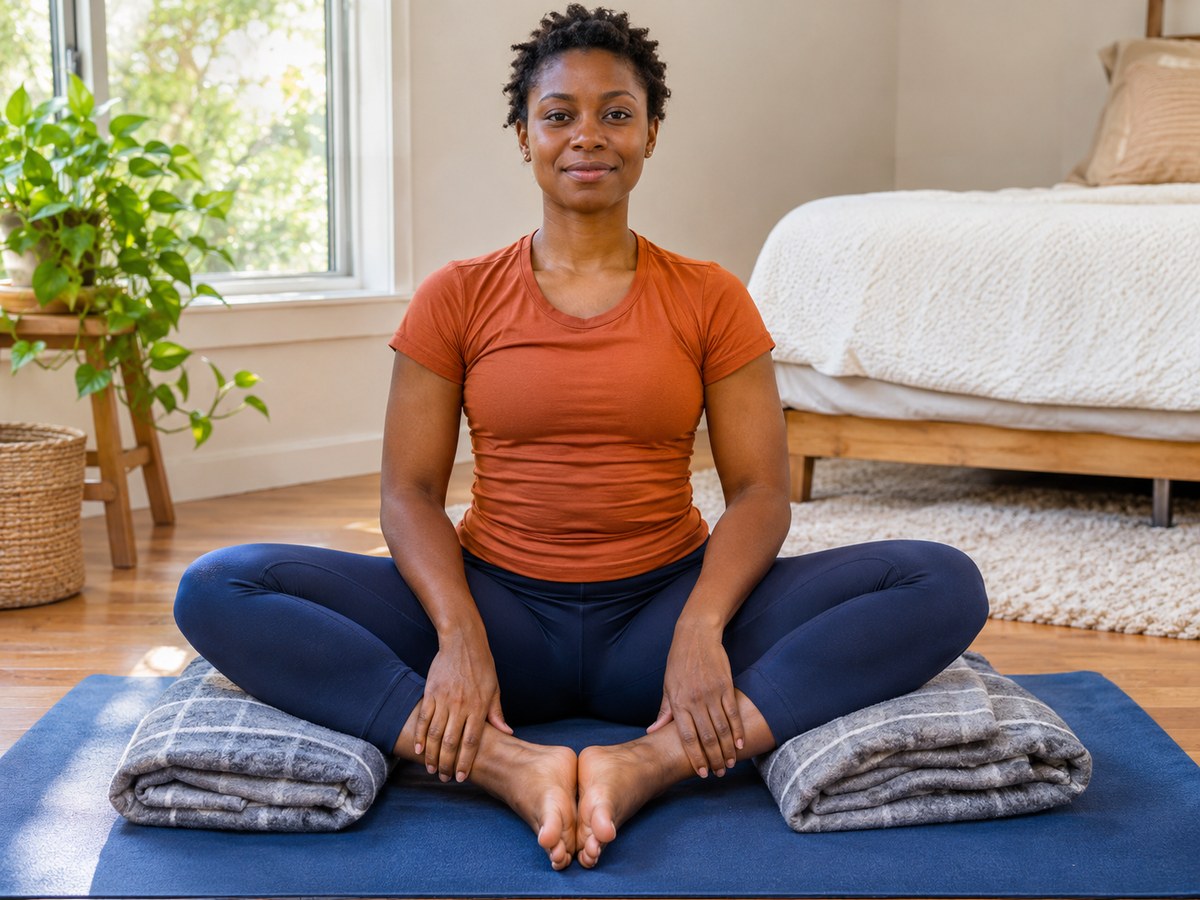
In Butterfly pose, the distance between your knees and the floor is not a score. A useful home question is whether you can sit comfortably with the legs supported, then leave the shape without pulling or pushing. You do not need to press the knees down to make the practice count.
This guide explores a gentle seated setup, often called Bound Angle or Baddha Konasana, with short attempts and rests. It does not promise pain relief, hip correction or a particular range of motion. If the shape is unfamiliar or you have concerns about your hips, knees or back, learn an appropriate version with a qualified teacher before practising alone.
Set up support before opening the knees
Choose a dry, clear floor with a mat that stays flat. Place two broad, firm folded blankets within reach. A firm folded blanket beneath your sitting bones is an option if it makes sitting more comfortable, but it should not form a wobbly stack. Keep enough room to extend both legs forward when you finish.
Sit upright, bend the knees and bring the soles of the feet together at a comfortable distance in front of you. The heels do not need to touch the pelvis. Let the knees open only as far as feels comfortable, with broad folded support beneath each outer thigh or knee area so the legs are not hanging unsupported. Adjust one side at a time, without forcing the other.
Keep the hands out of the pushing job
Rest the hands lightly near the ankles or on the floor. Do not use the elbows or palms to press on the thighs or knees. Keep the torso comfortably upright rather than pulling yourself forward by the feet. If the feet are too close, move them a little farther away and reassess; there is no required diamond size.
Cleveland Clinic's flexibility guidance includes a seated Butterfly stretch and recommends avoiding bouncing or forcing stretches. The supported, small-range setup and session clock here are editorial suggestions, not a reproduced clinical programme. A photograph cannot decide the right amount of support for your body.
A ten-minute practice with exits included
| Time | Suggested practice |
|---|---|
| 0:00–1:00 | Check floor, mat and blankets; arrange the resting space. |
| 1:00–3:00 | Warm up with comfortable walking and easy seated ankle movements. Take your time moving to the floor; skip this practice if the transition is not suitable. |
| 3:00–4:00 | Find a small Butterfly shape and position supports. Rest the hands and breathe normally. |
| 4:00–7:00 | Three one-minute blocks: allow20seconds to enter and settle, up to10seconds in a comfortable supported shape,15seconds to bring the legs back toward centre and extend them gently, then15seconds to rest. |
| 7:00–8:00 | Rest with the legs in any comfortable position. Do not use this minute for a deeper push. |
| 8:00–9:00 | Repeat one small supported attempt only if wanted, using the same one-minute block. Otherwise rest. |
| 9:00–10:00 | Finish and leave the floor using your usual safe transition, or remain seated if you need more time. |
The timer includes setup, warm-up, transitions and rests. It is a suggested ceiling, not a demand to get off the floor quickly. Replace attempts with rest if you need longer for a change of position. Stop the clock and finish early whenever appropriate.
How to leave without dragging the knees
Bring the hands to help guide the legs toward a comfortable central position if needed, without twisting the knees. Move slowly and remove the supports only when the legs no longer rely on them. Extend one leg and then the other, or choose another familiar comfortable resting position. Avoid snapping the knees together or pulling hard on the feet.
If the supported shape still feels uncomfortable, do not keep adding props in the hope of making it fit. Our blanket-or-chair seat guide addresses a different sitting option. You can also choose a practice without this pose; Butterfly is not a requirement for doing yoga.
Know when individual advice matters
Stop for pain, tingling, numbness, dizziness or a feeling of instability. Persistent or concerning symptoms need appropriate professional advice. Injuries, surgery, pregnancy-related needs and medical conditions may require a different practice or supervision. The presence of blankets does not prove that this shape is suitable for everyone.
NCCIH's safety guidance supports individual modifications and qualified instruction. This is a general practice idea, not a therapeutic protocol. Record which support and foot distance felt comfortable rather than measuring how low the knees travelled. For other prop decisions, see the yoga-props guide, or join the Sweat & Snack waitlist for future planning tools.