Articles are currently available in English.
Yoga
Cat–Cow at Home: Small Moves, Comfortable Range
By Sweat & Snack · 2026-11-03
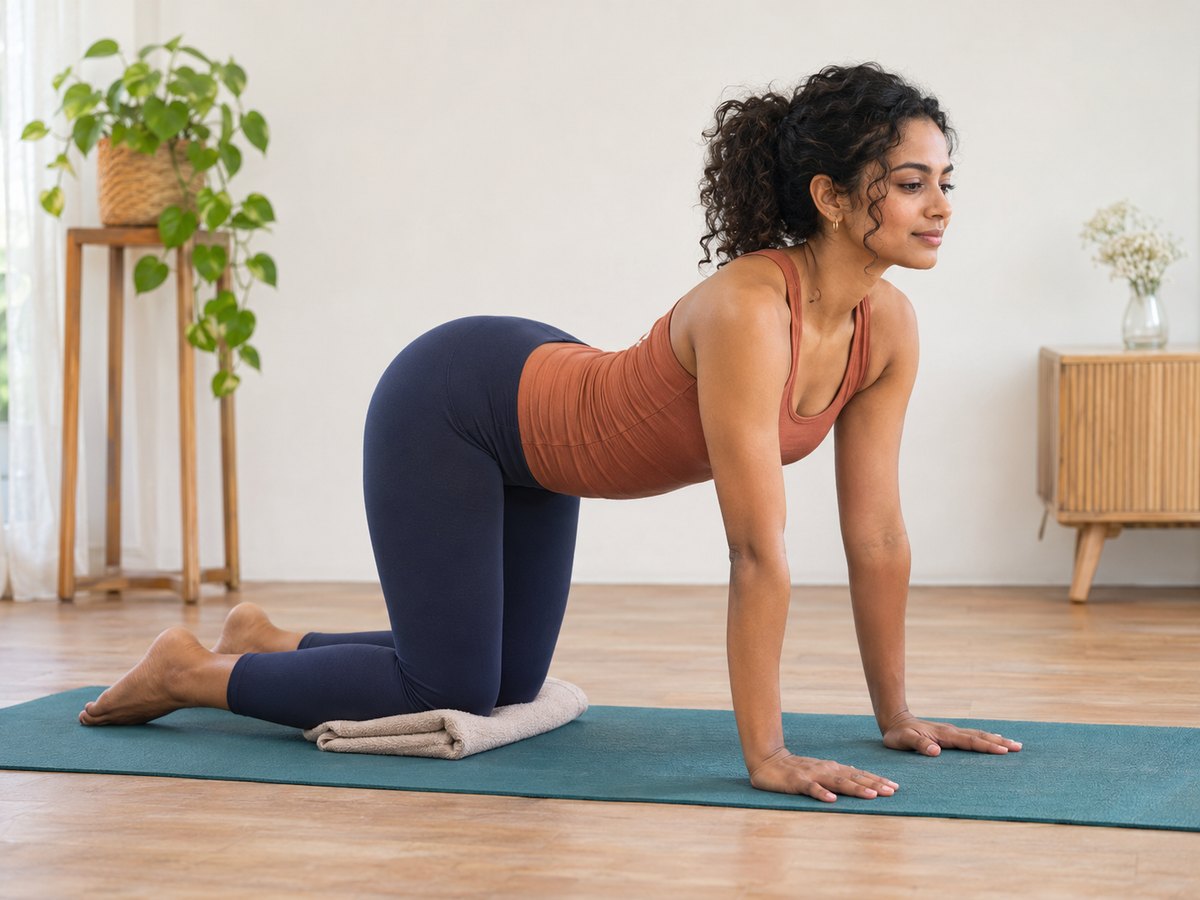
Cat–Cow does not need to look dramatic. For a home practice, start with the question: can you move gently between two shapes while your hands and knees stay comfortable? A deeper curve is not the target. This guide gives that one movement more attention than it receives in a flowing sequence.
Our suggested ten-minute practice includes warming up, getting down, pauses and getting up again. It is a learning example for adults who can comfortably bear weight on their hands and knees, not a treatment for back pain or an individual exercise prescription.
Prepare the floor before you move
Use a dry, nonslip mat on a stable surface, with enough space to place your hands and knees without touching furniture. Keep a folded towel nearby if you want modest knee padding. Check that it stays still. Put your timer where you can hear it; do not turn your neck repeatedly to watch a screen.
If getting to the floor, supporting yourself through your hands, or kneeling is uncomfortable, skip the floor movement. Sit comfortably on a firm chair instead and use the time to observe normal breathing. That is a different option, not a claim that a chair movement produces identical effects. Our no-floor chair guide offers another starting point.
Learn the two directions without chasing the picture
Health and Wellbeing Queensland's Cat and Cow guide starts on hands and knees and pairs a gentle opening of the chest with inhaling, followed by rounding the back while breathing out. It also suggests a towel if kneeling is uncomfortable. Our practice below uses time and pauses rather than prescribing its repetition count.
Place your hands approximately under your shoulders and knees under your hips, making small adjustments for comfort. Spread your fingers without forcing them. Begin between the two shapes. For Cow, let the chest move gently forward as the pelvis tilts; keep the neck long rather than throwing the head back. For Cat, allow the pelvis to tuck and the back to round gently. Do not pull the chin hard toward the chest.
Use a range in which you can keep moving quietly and return to the middle. If matching a movement to a breath feels awkward, reduce the movement and breathe normally. There is no need to hold your breath or make each breath unusually deep.
A ten-minute practice, including the quiet parts
- 0:00–5:00 — warm up. Walk gently around a clear room, adding comfortable shoulder rolls if you like. Keep the pace easy. This light-activity opening follows Queensland's warm-up approach; it is included in the clock.
- 5:00–6:00 — set up slowly. Move down to the mat in your usual comfortable way. Arrange the towel and find a steady hands-and-knees position. Take longer and shorten or skip the next section if needed.
- 6:00–7:00 — explore a few small changes. Alternate gently between the two directions, returning through the middle. Pause whenever needed. You do not have to keep moving for the whole minute.
- 7:00–8:00 — unload and pause. Move out of the weight-bearing position into a comfortable seated rest. Let your hands relax. Do not replace the pause with an extra stretch.
- 8:00–9:00 — repeat only if comfortable. Return to hands and knees and try the same small range. Alternatively, remain seated. This is a check of comfort, not an attempt to outperform the first minute.
- 9:00–10:00 — finish. Leave the floor calmly, using a stable support if appropriate, and stand or sit comfortably. If you need more time, take it; the timer never requires a rushed transition.
Make the next attempt clearer
Choose one observation: did you rush the middle, lift your chin to copy the photograph, or stay on your hands after they became uncomfortable? Change only that part next time. A useful note might be “smaller Cow, quieter neck,” rather than a score for how far you bent.
Stop if you feel pain, numbness, dizziness or symptoms that concern you. Do not keep experimenting through symptoms. Ask a qualified instructor about technique; discuss an injury, medical condition, pregnancy or uncertainty about suitability with an appropriate health professional. NCCIH's Yoga safety guidance explains why individual circumstances and qualified instruction matter.
This single-movement practice does not promise pain relief, injury prevention or a complete fitness session. If the movement itself is comfortable but the changes between positions feel hurried, read our short-sequence transition guide. You can also join the Sweat & Snack app waitlist for future planning tools.