Articles are currently available in English.
Nutrition
Oat or Soy Drink After the Gym? Compare Your Actual Pour
By Sweat & Snack Editorial Team · 2026-10-18
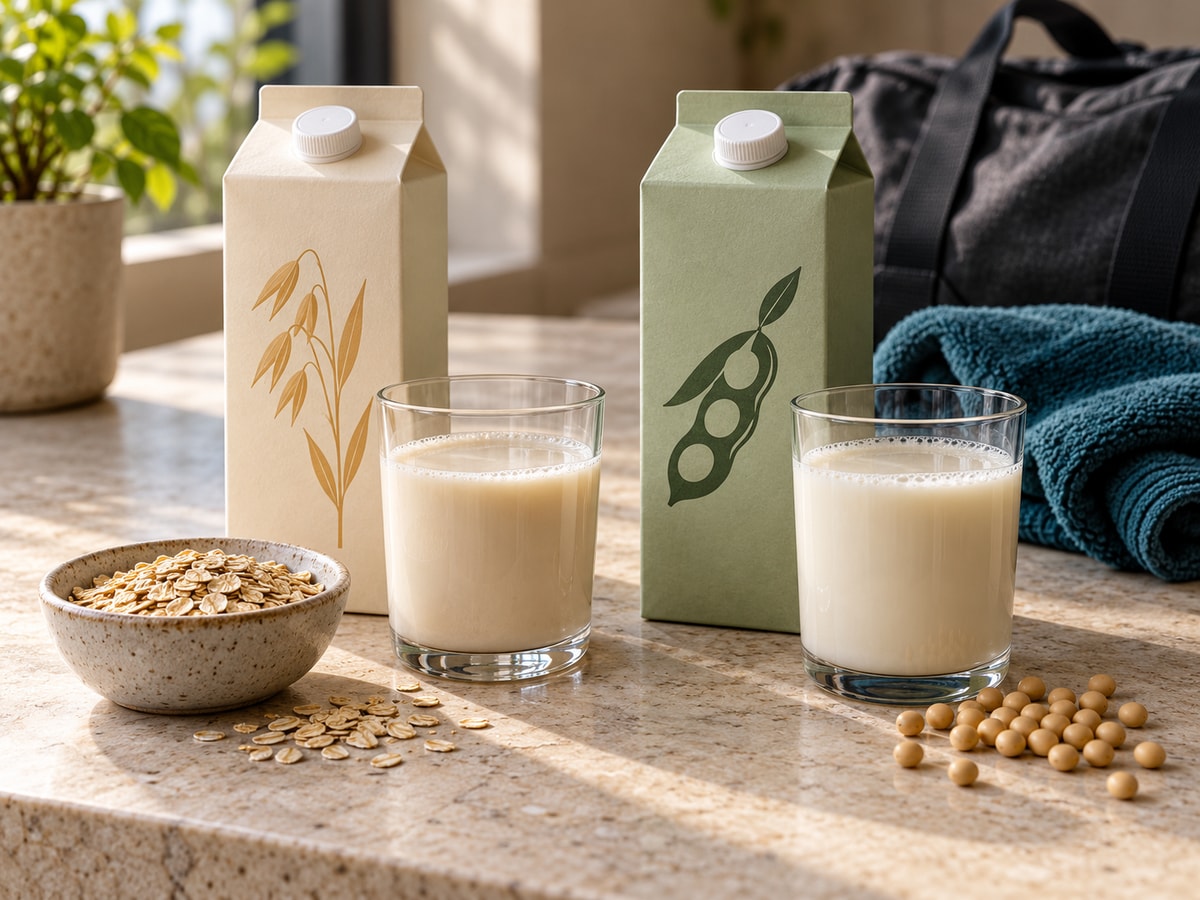
Choosing oat or soy drink for an after-gym snack? Compare the exact cartons, then calculate the amount you actually pour. A similar colour, carton size or coffee texture does not establish the same protein content. Check fortification separately, keep your allergy requirements first, and plan what happens after opening.
This is a practical substitution check for adults who already have a food routine. The examples below are suggestions and hypothetical label arithmetic, not a sports-nutrition prescription or a promise of faster recovery.
Start with the job of the drink
Before choosing a carton, finish this sentence: “I want this drink to contribute ___ to my snack.” Perhaps you want a particular taste, a drink alongside toast, or a protein contribution already specified in your own plan. Those are different shopping questions.
If dinner is the real decision, use our snack-or-dinner guide. Here the question is narrower: when you change the beverage, what changes in the snack you planned?
Compare the product, not just oat versus soy
The FDA explains that plant-drink nutrient profiles vary with the plant source, processing and added ingredients. Its consumer guidance recommends checking protein, calcium, vitamin D and potassium, alongside saturated fat and added sugars.
Use those as separate rows in a comparison. Added calcium does not tell you the protein amount. A familiar brand name does not tell you whether its original, unsweetened and barista versions share a nutrition panel. Nutrient values vary by brand, formulation, serving size and preparation; use your current package rather than a generic online total.
A carton check you can copy
- Write the exact product and version.
- Record the label basis: per 100 ml, per serving or per container.
- Note protein grams and the stated serving volume.
- Check calcium and vitamin D separately, then other nutrients relevant to your plan.
- Read ingredients, allergy information and storage directions.
This is an editorial shopping worksheet, not a ranking of every plant drink. A product can suit your taste without being interchangeable with the beverage it replaces.
Compare an equal volume, then your actual pour
The FDA label guide explains that nutrient figures refer to the stated serving and that serving size is not a recommendation of how much to consume. For a comparison, put both products on the same volume basis first.
Worked example: invented labels, not product data
Imagine Carton A lists 3 g protein per 100 ml. Carton B lists 4 g per 200 ml. At an equal 200 ml, A supplies 6 g and B supplies 4 g. If your actual pour is 150 ml, the arithmetic gives 4.5 g for A and 3 g for B.
The calculation is: label protein × actual volume ÷ label volume. These invented figures demonstrate the method; they are not average oat or soy values, a recommended portion or a target for recovery. Do not use them as real nutrition information.
Across countries, label layouts, reference values and declarations differ. Compare the units printed on your own packages. If a number is unavailable, keep it unknown rather than entering zero. The same measurement habit appears in our guide to matching food weight and nutrition data.
Make the swap visible in the whole snack
Try writing your snack as two parts: beverage plus food. For example, “my chosen drink alongside fork-mashed white-bean toast.” This is an assembly suggestion, not a nutritionally analysed combination.
If a replacement contributes less protein than the original and protein was the reason for choosing it, revisit the snack or your existing plan. You could choose another suitable carton, keep the drink for taste and reconsider the food alongside it, or ask a registered dietitian about your needs. There is no need to declare the lower-protein drink a bad food.
A label comparison cannot establish your personal protein requirement, an ideal post-workout deadline or a training outcome. Athletes with a specific fueling plan should check substitutions against that plan rather than treating this worksheet as a replacement.
Check allergies and the journey home
Soy is a food allergen. Read the full ingredient and allergy information every time you buy; a plant-based description is not an allergy guarantee. The FDA allergy guide also notes that U.S. advisory statements such as “may contain” are voluntary. Ask the manufacturer when suitability is unclear, and follow your established allergy advice. See our conditions and allergy information for the site's scope.
Follow the carton's storage instructions, including what changes after opening. Under FDA food-storage guidance, keep refrigerated food at or below 4°C/40°F. Perishables should not sit at room temperature beyond two hours, or one hour above 32°C/90°F. An unopened shelf-stable carton and an opened carton are different packing decisions; check our no-fridge journey guide.
Save one useful substitution note
Keep a note of the exact product, your usual pour, the protein calculation, fortification and storage instruction. Recheck it when the package changes. Browse our curated nutrition examples for wider food context.
Sweat & Snack is planning an app for more personal food choices, substitutions and preparation reminders. Join the app waitlist if you want to follow its development. For now, this small comparison can make one shopping decision clearer.