Articles are currently available in English.
Nutrition
Roasted Chana After the Gym? Check the Packet First
By Sweat & Snack Editorial Team · 2026-10-16
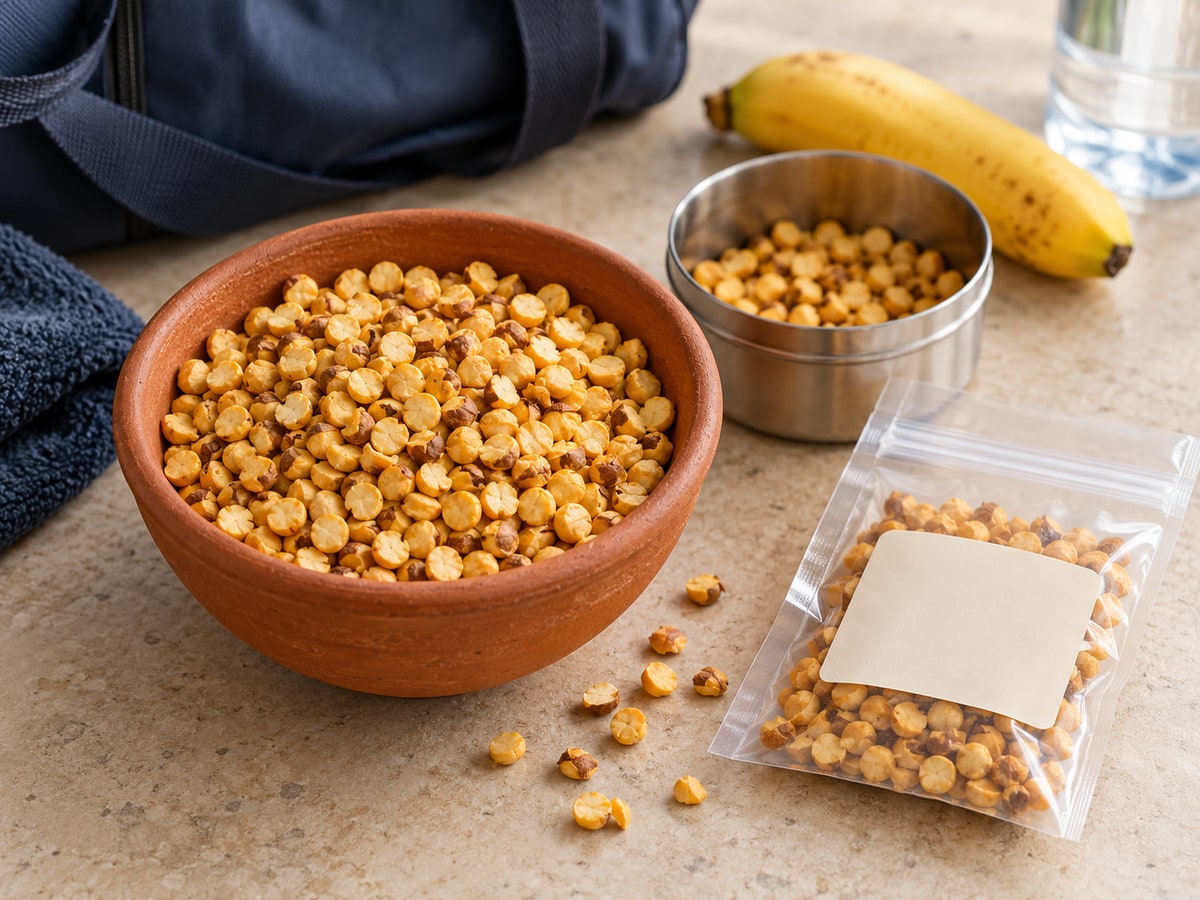
Ready-to-eat roasted chana can be one savoury option when you want a snack after the gym. Before packing it, check which product you have, whether its nutrition figures are per serving or per 100g, and the amount you actually plan to eat. A large protein number on the front of a packet does not tell you what is in your snack tin.
This is a practical packet-reading and packing guide, not a prescribed recovery meal. The serving ideas are suggestions. Choose food that suits your preferences, appetite and individual dietary needs; there is no promise that one snack will produce a particular training result.
First, identify what is in the packet
Look for a product explicitly sold as ready to eat. Read the full name and ingredient list rather than relying on the word chana. You might be looking at plain roasted gram, a salted version, a coated product or a snack mixture containing several foods. Note what the specific packet says instead of treating them as the same purchase.
Raw dried gram intended for cooking is a different product. Follow its preparation instructions; do not put it straight into a snack tin as a substitute for a ready-to-eat roasted snack. Likewise, a nutrition table for cooked chickpeas is not the table printed on your roasted-gram packet.
Use the ingredient and allergen information together
Check for ingredients you avoid and read any allergen declarations. If you have a food allergy, use your own allergy-management advice and clarify an unclear label with the manufacturer. A product name, vegetarian mark or front-of-pack slogan cannot answer every ingredient question.
Find the basis of the nutrition figures
Locate the heading above the nutrition table. Is the information for 100g, one serving, or another stated quantity? Then find the packet's net weight and any stated serving weight. These are different pieces of information. FSSAI's consumer guidance asks readers to check the label basis and the amount actually consumed.
A useful order is: read the units, note the stated amount, then look at the nutrient you are interested in. This avoids comparing one product's per-serving protein figure with another product's per-100g figure.
If the table gives values per 100g
For a weighed portion, multiply the listed nutrient amount by your portion weight in grams, then divide by 100. Use the actual packet's figures. If a label already gives information for the exact serving you have measured, use that column instead. The same arithmetic applies to protein, carbohydrate or sodium, keeping the printed units unchanged.
Without the label and a portion weight, we cannot give a reliable total for your snack. A handful or a katori can be a convenient way to serve food, but it does not supply the grams needed for that calculation. You do not have to calculate every snack; simply avoid treating an unknown amount as an exact nutrition total.
Compare the whole choice, not only protein
Beans, peas and lentils, including chickpeas, are recognised protein foods in Canada's Food Guide. That general classification does not establish the protein content of every finished snack product. For your particular roasted chana, use its own label rather than borrowing a figure from a different food or brand.
If choosing between two packets, compare the same amount of each and look beyond a single headline number. Read the ingredients and the available protein, carbohydrate, fat, fibre and sodium information. A packet's stated serving is a reference for reading its figures; it is not a personalised instruction about how much you must eat.
Our fibre-label guide explains another part of the panel. This guide adds the roasted-chana shopping and packing decisions rather than assigning one universal portion.
Fit the snack around the rest of your afternoon
As a serving suggestion, you could put some ready-to-eat roasted chana in a small container and take a whole banana separately if you would enjoy both. Another option is eating the chana at home alongside a bowl of plain curd. These are ordinary food combinations, not calculated recovery formulas or requirements.
If dinner is close and you do not want a snack, use our snack-or-dinner decision guide to think through the situation. If you are hungry and a meal is much later, plan what you would like to eat rather than expecting a tiny packet to suit every afternoon.
Keep the packing plan matched to the food
Follow the packet's storage directions, including any instructions after opening. Keep the packaging or a clear photograph of its label so you can check ingredients and storage details later. Use a clean, dry container if transferring the snack, and label it so another person knows what it contains.
Adding curd, cut produce or other foods that require refrigeration changes the packing plan. Keep those foods appropriately chilled. FDA guidance says foods needing refrigeration should not remain at room temperature for more than two hours, or one hour when the air is above 32°C. Read our no-fridge gym-bag guide for the journey and cold-storage questions.
A quick check before leaving
- Is this product ready to eat, and have I checked its ingredients?
- Do I know whether the nutrition figures are per serving or per 100g?
- If I am calculating a total, do I have the actual portion weight?
- Does the packet explain how to store it after opening?
- Have I planned cold storage for anything chilled that I am adding?
You can make that check once for the packet you use regularly, then revisit it when the product or your packing plan changes.
Sources
FSSAI Eat Right India: How to Read Labels
FDA: How to Understand and Use the Nutrition Facts Label
Canada's Food Guide: Eat Protein Foods
FDA: Are You Storing Food Safely?