Articles are currently available in English.
Exercise
Step-Ups on a Low Stair: A Simple Supported Start
By Sweat & Snack · 2026-10-26
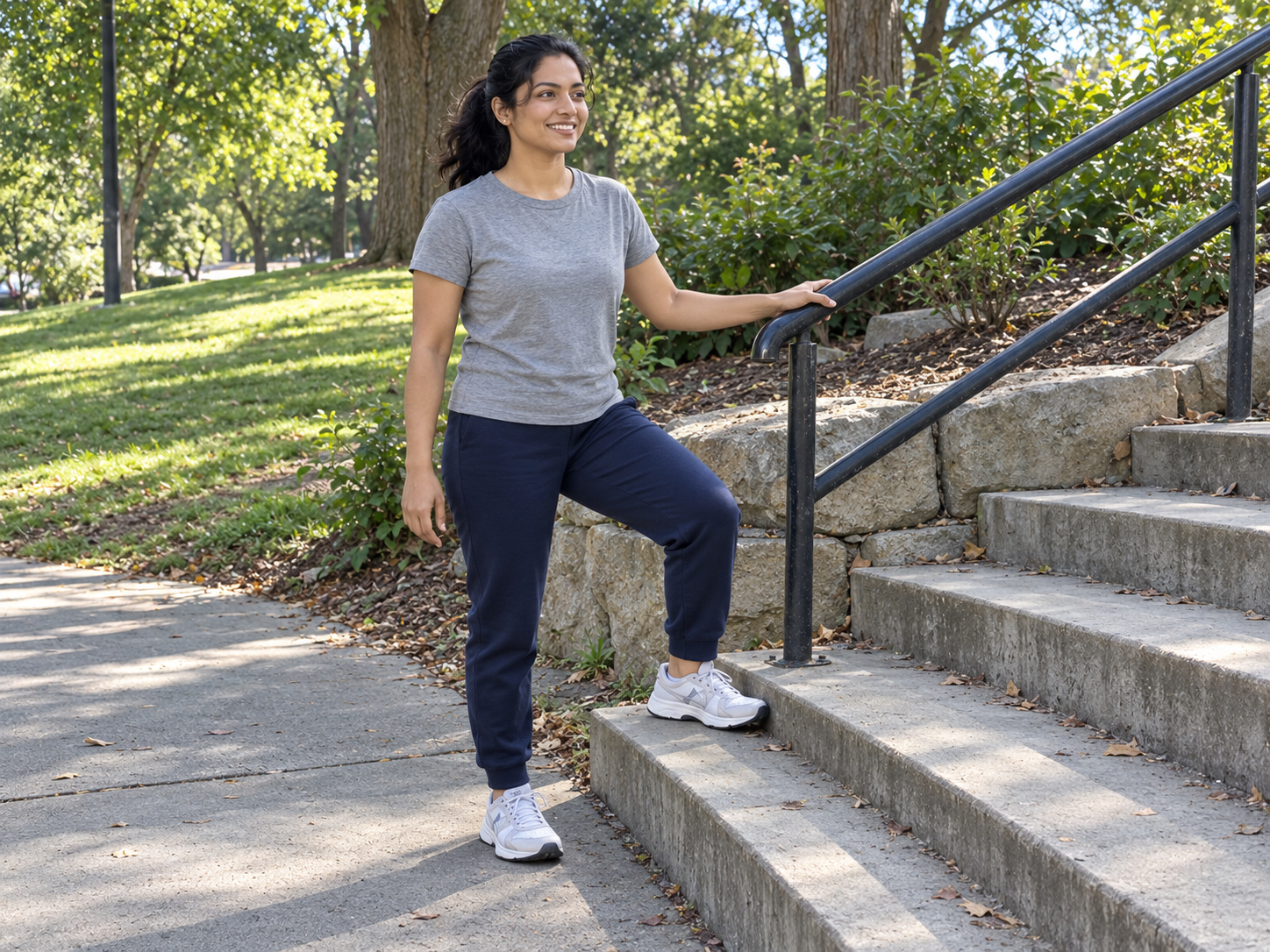
A low, fixed stair with a solid rail is enough to explore a basic step-up. Before moving, check that the stair is dry, clear and not too high for you to step onto comfortably. The photo shows a suggested setup at an outdoor stair, with one hand on the rail and the whole leading shoe on the step. It does not prescribe a particular height, pace or number of repetitions.
A step-up sounds simple until the step is too tall, the surface is slippery, or the rail is too far away. Treat those setup details as the first part of the exercise. If a good stair is unavailable, choose level-ground walking or another suitable movement rather than improvising with an unstable box, chair or loose object.
Check the stair before you start
Use the bottom step of a fixed staircase where you can see both the tread and the ground. Look for a dry, unobstructed surface, secure footwear and a rail you can reach without twisting. Make sure you have room to step back down. The NHS balance exercise page recommends a step with a railing or wall nearby and emphasizes slow, controlled movement.
Choose a stair low enough that you can place the entire leading foot on it without having to swing the body or pull hard on the rail. The rail is there for steadiness. If you must haul yourself up with the arm or cannot lower yourself comfortably, that stair may be too high for this practice today.
Try one controlled step-up
Suggested sequence
- Stand close to the step, upright and within easy reach of the rail.
- Put the whole of one shoe on the tread. Pause and check where the foot is placed.
- Transfer weight gradually and step up. Bring the other foot onto the step if you can do so without rushing.
- Step down in a controlled way, using the rail as needed. Reset on level ground before another repetition.
- If you repeat, try both leading legs rather than doing every step on one side.
The ACE step-up instructions describe controlled upward and downward phases and attention to foot, ankle and knee position. Those instructions are a reference for movement quality, not a requirement to add dumbbells or balance on one leg. For this beginner version, leave weights out and prioritize the stable stair.
Make it easier or stop
Start with just one or two exploratory repetitions if you are unsure about the setup, then decide whether the movement remains comfortable. You can hold the rail more firmly, use a lower step, or return to level ground. Stop if you feel pain, dizziness or a loss of balance. Anyone with an injury, fall risk or a condition affecting exercise should seek individualized advice before using this as a routine.
This guide complements the walking uphill effort guide, which addresses changing pace on a slope, and the beginner workout log, which helps record what you actually did. A step-up is one movement option; it need not become a full workout or a promise of a particular result.
Image note: the illustrative photograph and Pin graphic were generated with AI from a user-supplied visual reference.