Articles are currently available in English.
Exercise
Workout Log for Beginners: What to Write After Each Set
By Sweat & Snack Editorial Team · 2026-10-17
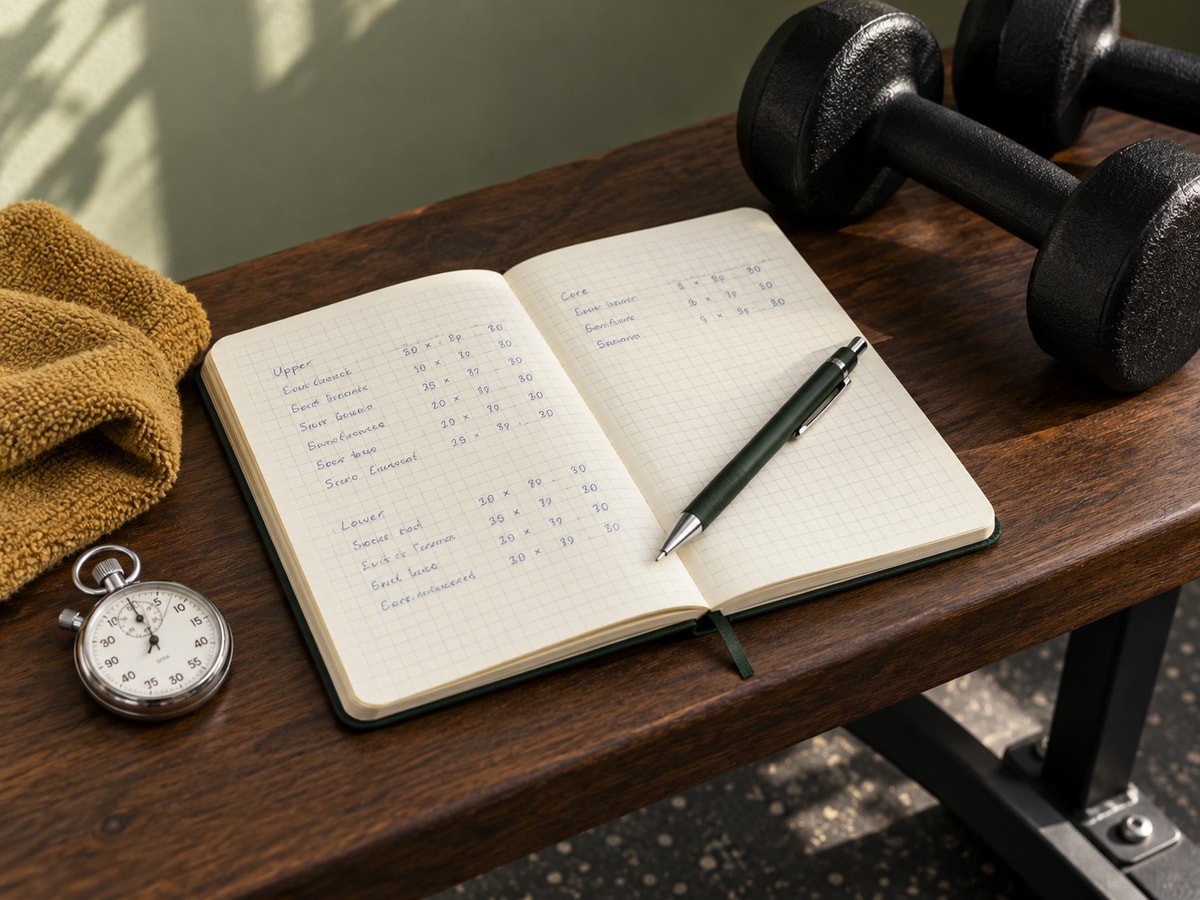
For a beginner workout log, write the date, the exact exercise, the resistance used and the repetitions you actually completed in each set. Add a short note when the setup or session changes. A notebook or a plain phone note is enough to start.
The format below is a practical organisation suggestion for home strength sessions, not a training prescription. Its numbers illustrate how to write a record; they do not tell you which weights, exercises or targets are suitable for you. Use a plan you understand and ask a qualified instructor about unfamiliar movements.
Keep the plan and the result separate
Before starting, put your planned exercise names at the top of the page. After each set, record what happened. If the plan says eight repetitions and you complete six, write six. If you skip a movement, write skipped instead of copying the target into the result column.
In exercise terminology, a repetition is one complete movement; repetitions grouped together form a set. The NHS strength guidance explains these terms and recommends starting gradually. The log is a place to describe your session, not a reason to rush that process.
Five fields for your first page
1. Date and exercise version
Use a name you can recognise next time: wall push-up, seated dumbbell curl or another movement from your own plan. A wall push-up and a floor push-up need separate names. If an instructor has given you a particular variation, keep that wording.
2. Resistance and its unit
Write kilograms or pounds beside the number. For dumbbells, make the convention explicit: 3 kg each hand is clearer than 6 kg. That example is notation, not a starting-weight recommendation. Our first dumbbell weight guide covers the separate choice of resistance.
For bodyweight work, write bodyweight and the variation. For a backpack, record the measured loaded weight if you know it; otherwise list the contents and mark weight unknown. For a band, note its brand or identifying label and setup rather than inventing a kilogram equivalent.
3. A result for each set
Give each completed set its own space. A compact entry might say set 1: eight reps; set 2: six reps. For a movement performed separately on each side, label left and right instead of silently adding them together. Keep your chosen convention consistent.
4. Rest or an interruption
If your plan uses timed rest, note the interval you used. If you did not time it, write not timed. A doorbell, phone call or equipment change can go in a short note. See our home rest-between-sets guide for choosing a pause; this page explains only how to record one.
5. One useful observation
Choose ordinary descriptions: learning the setup, changed chair, instructor corrected grip, or stopped before planned total. You can add an effort note in your own words. There is no need to invent a precise score or a diagnosis to fill a box.
A copyable home-workout example
Illustrative entry only: 17 October — wall push-up — bodyweight — set 1: eight reps; set 2: six reps — rest not timed — moved to a different wall before set 2. This is an example of record keeping, not a recommended session.
For a blank version, copy these labels into a note:
- Date:
- Exercise and version:
- Resistance, unit and per-hand convention:
- Set 1 / set 2 / any further planned sets:
- Rest or interruptions:
- Observation or question for my instructor:
Only add spaces for the sets in your own plan. If you are learning a wall push-up, the version and instructor's setup notes may be more useful to you than a page of extra statistics.
Review the entry before the next session
As a practical suggestion, read the last entry for the same exercise before you begin. Check the unit, exercise version and equipment. If those differ, note the change instead of treating two numbers as directly interchangeable.
Use the record to prepare a specific question: should I keep practising this setup, or is it time to review my plan? The NHS home strength page advises building up slowly. A higher number on one day is not an instruction to increase resistance at the next session.
If you have health problems, Mayo Clinic advises speaking with your healthcare professional before starting strength training. Logging does not replace that advice or instruction on technique.
When the page has gaps
What if I forget a set?
Write not recorded. Keep remembered details clearly labelled as estimates rather than replacing a blank with the planned target. You can simplify the next page if the format takes too much attention.
What if I miss the whole workout?
Mark it missed and keep the next plan separate. Our missed-workout guide explores scheduling choices. The empty row does not need to become a catch-up challenge.
Paper or phone?
Choose whichever you can use conveniently and keep in one place. If you use paper, put the notebook with your equipment. If you use a phone, save a blank note to duplicate. Keep the log personal, brief and readable enough to use again.
Sources
Checked 17 October 2026. The logging layout and examples are editorial suggestions; general terminology and gradual-start context come from the sources below.
NHS: How to improve strength and flexibility
NHS: Strength exercises
Mayo Clinic: Strength training video collection and starting guidance