Articles are currently available in English.
Exercise
Treadmill Says 6: Is That km/h or mph?
By Sweat & Snack Editorial Team · 2026-10-19
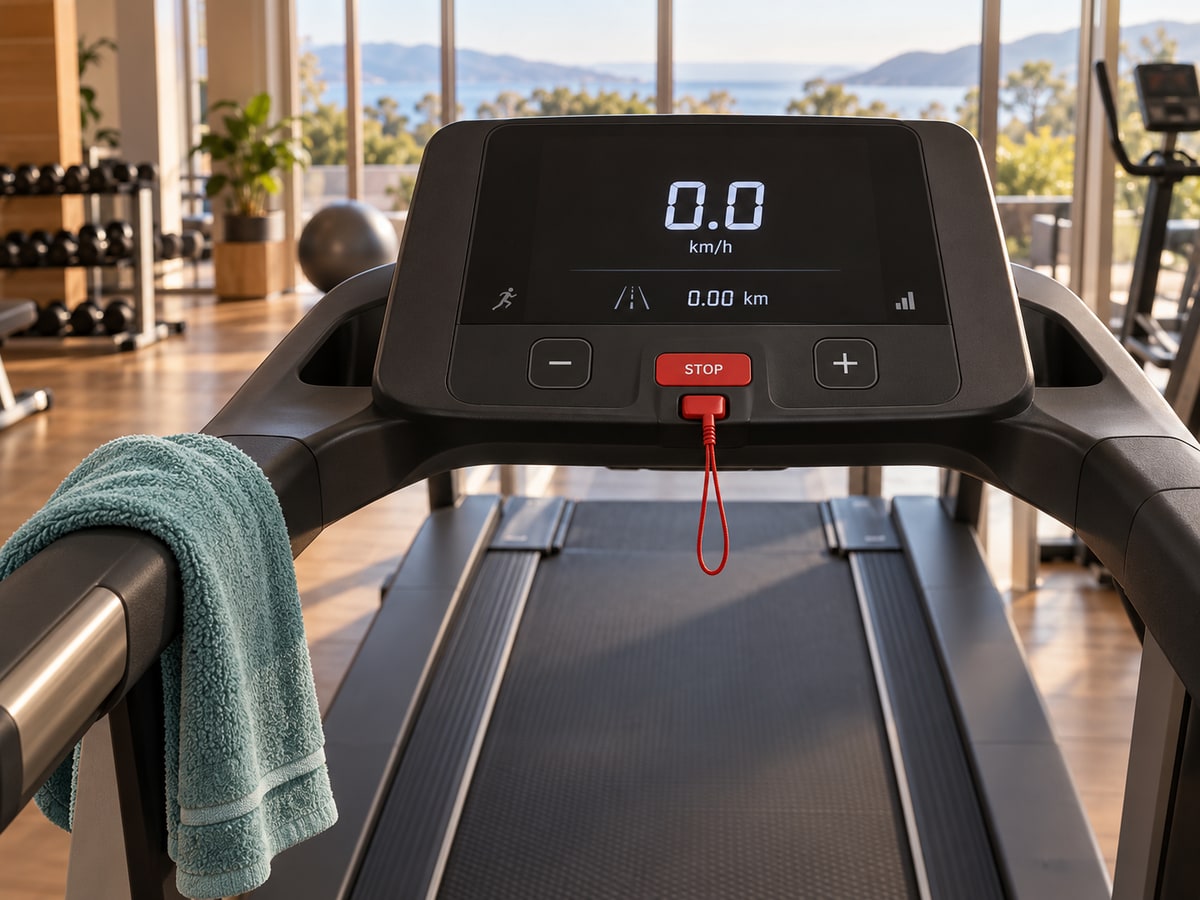
A treadmill showing 6.0 does not tell you its speed until you know the unit. 6 km/h is about 3.7 mph; 6 mph is about 9.7 km/h. Before copying your usual number onto an unfamiliar machine, check the label beside the speed display. If it remains unclear, ask gym staff before starting.
This guide helps you read and record a setting. The examples are arithmetic, not suggested walking or running speeds. Your experience, training plan and the machine's instructions still matter.
Check the unit before choosing a number
Read the speed field itself
Look for mph or mi/h, meaning miles per hour, or km/h or kph, meaning kilometres per hour. Check that the number belongs to speed rather than elapsed time, distance or incline. A photograph of another machine's console cannot establish what yours displays.
Unit configuration is model-specific. For example, Life Fitness documents a Units setting for speed and distance on its Atmos treadmill with an SL console. That same manager menu includes service settings. Its manufacturer guidance is an example, not a button sequence for every treadmill.
On shared equipment, ask staff to identify the unit and explain the ordinary start and stop controls. Leave manager and service menus to the people responsible for the machine. Follow the exact model's operating instructions; do not increase speed just to guess the unit from how the belt feels.
Translate the setting, keeping the unit attached
NIST's unit-conversion guide gives the factor: multiply mph by 1.609344 to obtain km/h. Divide km/h by 1.609344 to obtain mph. The examples below are rounded to one decimal place.
| Speed in mph | Equivalent km/h, rounded |
|---|---|
| 3.0 mph | 4.8 km/h |
| 4.0 mph | 6.4 km/h |
| 5.0 mph | 8.0 km/h |
| 6.0 mph | 9.7 km/h |
Read each row across. It does not mean that 3.0 km/h equals 4.8 mph. For the reverse example, 6.0 km/h divided by 1.609344 is approximately 3.7 mph. Keep the original and converted values together so you can check the direction of the calculation.
Use the result as a reference
A console may offer increments that do not match your calculated value exactly. Note any rounding rather than calling it an exact match. Translating the unit also does not establish that two machines deliver an identical experience or that the setting suits you today.
Speed, pace and distance answer different questions
Speed expresses distance per hour. Pace expresses time per distance: for instance, minutes per kilometre or minutes per mile. Distance is the amount covered. Keep those labels separate when moving a plan from a watch, training note or another console.
At a constant displayed speed of 6 km/h, the arithmetic pace is 10:00 minutes per kilometre: 60 divided by 6. At 6 mph, the arithmetic pace is 10:00 minutes per mile. The same digits belong to different units. These calculations do not measure the belt's calibration.
Keep the effort question separate
CDC explains that relative exercise intensity depends on the person. Its talk-test guidance describes moderate effort as being able to talk but not sing. A converted speed alone cannot classify your effort or establish that a session is appropriate for you.
If you are new to treadmills, a useful first step is a staff-led introduction to the machine and a plan appropriate to your experience. If you already follow a coach's programme, take the original unit, converted value and any equipment uncertainty back to that coach. Neither path requires copying somebody else's setting.
Leave a useful note for your next gym
A travel-log example
You could write: “Home plan: 6.0 km/h. Hotel console: mph confirmed by staff. Mathematical equivalent: about 3.7 mph. Actual setting and duration: record after the session.” Keep the actual session separate from the planned conversion; do not fill in a workout you have not done.
Consider saving the machine model, unit, actual speed, duration and the displayed incline with its label. A short note about how the session felt gives you something concrete to discuss with your trainer. Our workout-log guide explains the broader habit of recording what you actually did.
If equipment changes disrupt the rest of your session, see choosing a gym-machine backup. For a different setting, our walking-break guide covers planning movement around everyday clothes.
Before you press start
Identify the speed unit, check the original plan's unit, and keep any conversion labelled. If the display or controls are unclear, get help from staff instead of testing a guess. There is no need to turn an unfamiliar console into an extra training challenge.
Interested in Sweat & Snack's planned tools for organising exercise and everyday routines? Join the app waitlist for product updates.