Articles are currently available in English.
Yoga
Yoga Mat on Carpet? Check the Setup Before You Start
By Sweat & Snack Editorial Team · 2026-10-16
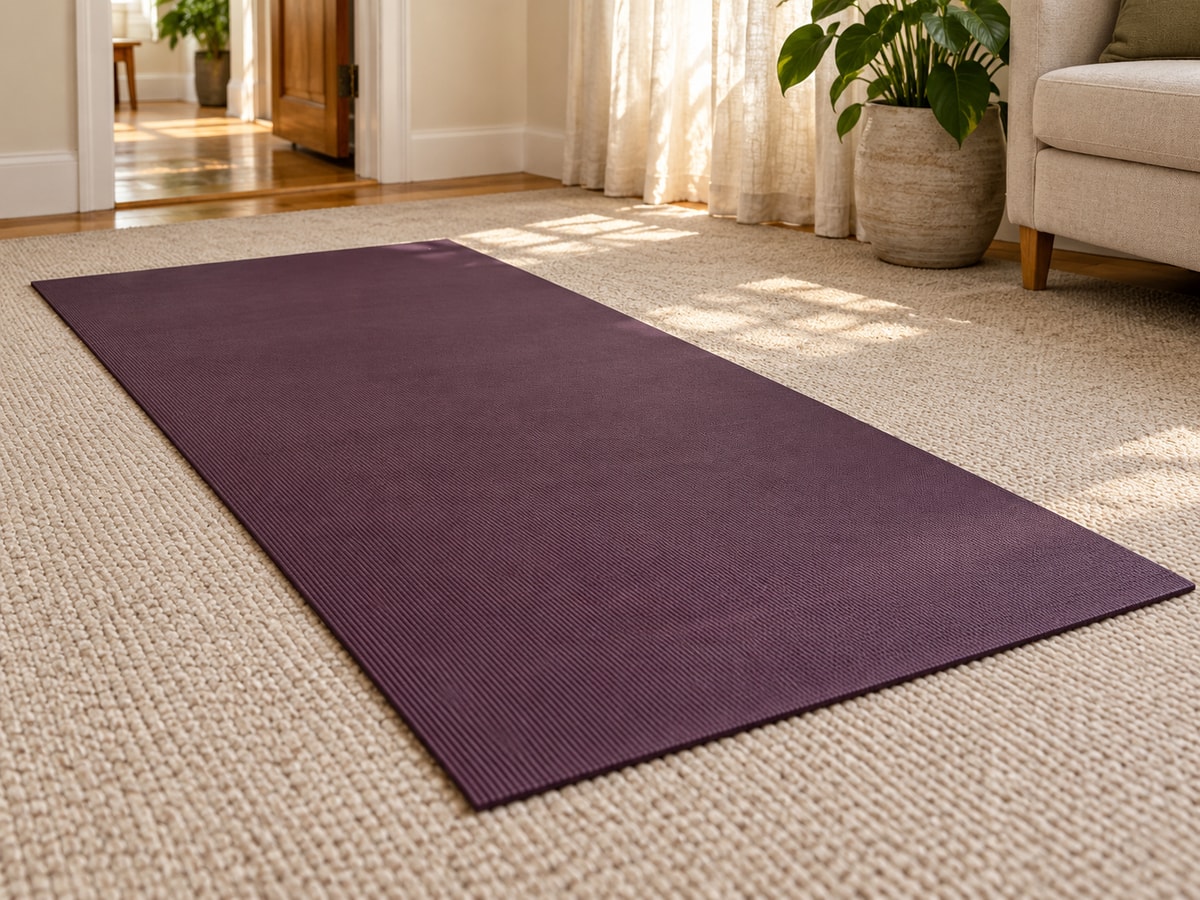
A yoga mat on carpet needs a check in the room where you plan to use it. Before starting a lesson, look for a mat that lies flat and stays in place; if it shifts, gathers into folds or feels unreliable, pause and choose another setup. A thickness measurement or a product label alone cannot tell you how your own mat will behave on your own floor.
The checklist below offers practical organising suggestions for home practice. It is not a test that certifies a surface as safe, and it does not replace a qualified instructor's advice. You can use it with the equipment you already have before deciding whether to change anything.
Check the carpet and mat as one setup
Start with the actual spot you intend to use. Is it fitted carpet, or a loose rug that can move separately? Does the mat lie flat across its full length? Can you see a curled corner, ridge or fold before stepping onto it? If something already looks out of place, sort that out before pressing play.
Liforme's home-practice guidance highlights resistance to bunching and rippling as a consideration on carpet. That is a useful equipment question, but it is manufacturer guidance rather than independent proof that a particular mat makes every carpet suitable. Avoid turning a seller's description into a guarantee about your room.
For a first pass, you could remove small objects, put cables outside the practice area and keep the doorway clear. Place the screen where you can see the instructor without positioning it on the mat. Our beginner yoga video checklist covers choosing a lesson; this guide deals with the floor underneath it.
Separate three different observations
- The whole mat moves: note whether its edge changes position relative to the carpet.
- The mat bunches: note whether it gathers into a ridge or fold.
- Your contact with the top feels unreliable: describe that separately when asking for advice, even if the mat itself stays still.
You do not need to perform a difficult pose to collect these observations. If simply getting into position feels uncertain, stop there. A short description of what happens will be more useful to a manufacturer or instructor than saying only that the mat is slippery.
Match the space check to the lesson
As a planning suggestion, preview the lesson before laying out your equipment. Does the teacher move beyond the long edges of the mat, change direction or ask for a chair or blocks? Leave space for the movements the lesson actually includes. A mat fitting between a sofa and a bed does not answer those questions.
Choose familiar, beginner-appropriate instruction rather than using an unfamiliar balance or inversion to test the floor. NCCIH recommends learning under a qualified instructor and advises beginners to avoid extreme practices such as headstands and shoulder stands. If you have a health condition or an existing injury, discuss your individual needs with your clinician and instructor.
If the setup changes during practice
Pause the video when you notice movement or a fold. Step out of the activity in a way you already know, then reassess the space. You could move to another suitable area or leave the physical session for a time when you can ask an instructor. There is no need to keep pace with the recording while adjusting equipment.
Ask about your exact mat before buying another
If carpet is your only available floor, identify your mat's brand and model. Then ask its maker whether that model is intended for your type of carpet. Include whether the carpet is relatively firm and close-woven or soft and deep, and describe any shifting or folding you noticed.
Here is a message you could adapt: “I use this mat on fitted carpet. It gathers into a fold when I change position. Is this a suitable surface for this model, and what setup do you recommend?” If you are considering an underlay or a portable practice surface, ask about compatibility with both the mat and the floor before adding it.
As a practical choice, avoid buying by thickness alone or assuming that stacking spare mats will solve the issue. Start with the problem you observed and seek advice about that combination. Our yoga props guide can help organise separate questions about blocks, straps and blankets.
Have an alternative for a carpet-only room
If the setup remains unreliable, you could save the video and practise elsewhere another day, attend a class, or ask a teacher to help plan a different session. A chair-based yoga plan may be a useful topic to discuss, but it requires its own suitable chair and floor setup; it is not an automatic workaround for every room.
For a shared home, you could agree on a temporary clear area and a time when people will not need to walk through it. Put equipment away afterwards according to its care instructions. These are household planning ideas, not requirements for a particular number of minutes or sessions.
A short note for your next session
Record the mat model, the room, what you observed and any advice you received. Next time, use that note as a starting point and check the setup again, especially if you have moved furniture or changed equipment. The useful outcome is a clear decision: use a suitable setup, change it, or ask for help before continuing.
The photograph is an AI-generated illustration of a mat and carpet. It does not show a tested product or certify the pictured arrangement.
Sources
Liforme: Yoga Mats for Home Practice
NCCIH: Yoga — Effectiveness and Safety