Articles are currently available in English.
Yoga
Legs on a Chair: Set Up a Comfortable Yoga Rest
By Sweat & Snack · 2026-11-04
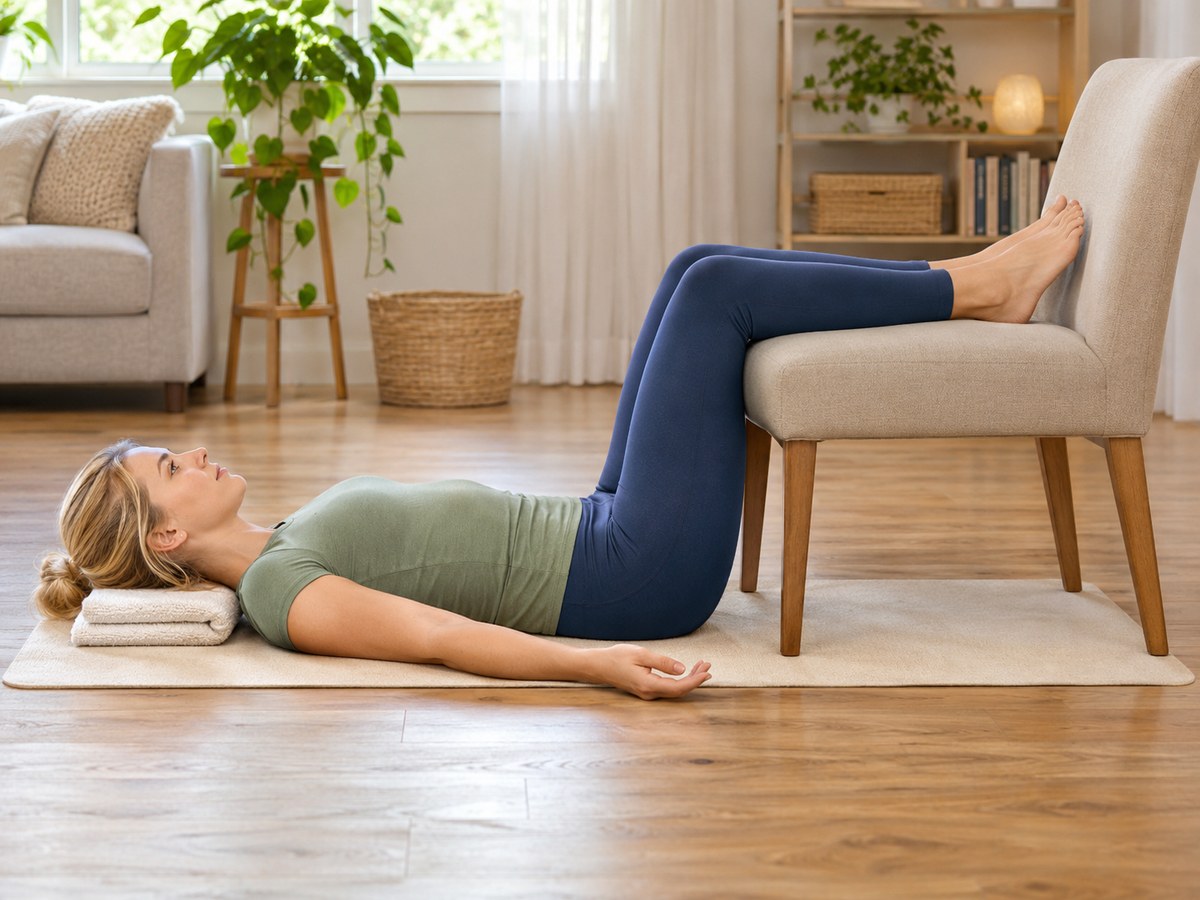
A chair can support your lower legs during a short Yoga rest, but the useful question is not how high you can lift your feet. It is whether the chair, your head support and the route back to sitting suit you. This guide focuses on that setup and exit, rather than adding another flowing sequence.
This is a suggested home practice for adults who already get down to and up from the floor comfortably. It is not treatment for back pain, swelling, poor circulation or sleep problems. If lying on your back is uncomfortable, or you have an injury, pregnancy or a condition that affects movement, ask a qualified instructor or health professional about an appropriate alternative. You do not need to use the floor to take a quiet pause.
Choose a chair you can trust
Use a sturdy, broad-seated chair with four stable legs, no wheels and no rocking or folding action. Remove loose cushions that slide. Put it on a dry, level surface and check that it does not move when you gently test it. A decorative stool, rolling office chair or soft pile of cushions is a different setup. Do not improvise a tall stack to make the photograph's height work.
Lay a mat in front of the seat, leaving clear space beside your body for getting down and rolling onto your side. Move bags, cables and small tables out of that route. Keep a thin folded towel nearby if a little head support feels comfortable. Its job is not to push the chin toward the chest. Leave enough light to see your surroundings and choose a time when nobody will move the chair.
Try the shape briefly before settling
Sit beside the mat and lower yourself through a comfortable side-lying position, using your hands as needed. Come onto your back and place one lower leg, then the other, on the seat. Adjust your distance so the calves are supported and the knees bend comfortably. The chair edge should not dig into the backs of your knees. Your hips and trunk stay on the mat; this is not a shoulder stand.
Rest the arms somewhere easy and let the neck stay neutral. Look upward without trying to turn your face toward a camera. If the head support feels too thick, reduce it; if the seat creates pressure or the position does not feel comfortable, leave the shape. Changing furniture height is not a reason to strain or force the knees into a particular angle.
A chair-supported lying rest appears as one option in Yoga International instructor Allison Ray Jeraci's chair Yoga practice. The choices and short clock below are our editorial suggestions, not a tested clinical protocol or a promised result.
A ten-minute setup, rest and exit
- 0:00–2:00: prepare and warm up. Check the chair and floor. Sit comfortably, move the shoulders gently and make a few easy ankle movements. Keep breathing ordinarily.
- 2:00–3:30: enter and check. Lower yourself with support from your hands, place the legs on the chair and check pressure, neck position and breathing. Take longer if needed.
- 3:30–5:00: first short rest. Stay only while comfortable. There is no breathing count to achieve and no need to feel especially calm.
- 5:00–6:00: reassess. Notice any pressure. You may lower one foot at a time and finish with both feet on the mat, or begin leaving the floor.
- 6:00–8:00: optional second rest. Continue with the chair only if it still suits you. A comfortable seated pause is equally acceptable.
- 8:00–10:00: leave gradually. Bring the feet down one at a time, pause, roll onto one side and use your hands to come to sitting. Settle before standing. Extend the exit instead of rushing to meet the timer.
Use less support when it is simpler
If the seat is too high, hard or narrow, choose a different position instead of forcing this one. Bent knees with feet on the mat remove the chair entirely. If floor access is the difficulty, our no-floor chair practice provides another starting point. A brief seated rest needs no special achievement or posture depth.
Stop for pain, numbness, dizziness or feeling unwell. Do not remain still through a symptom because a timer is running. NCCIH safety guidance recommends appropriate instruction and modifications for individual needs. Pregnancy can require changes to practices involving time lying on the back; this general article is not a prenatal plan.
For a moving reclined session, see our strap practice; for choosing between slower class styles, see Yin and restorative Yoga. Today's contribution is the chair check, supported-leg setup and unhurried exit. The photographs show fictional AI-generated adults and illustrate options rather than a body shape you need to copy.