Articles are currently available in English.
Exercise
Next Dumbbell Too Heavy? Progress Before You Jump
By Sweat & Snack · 2026-10-21
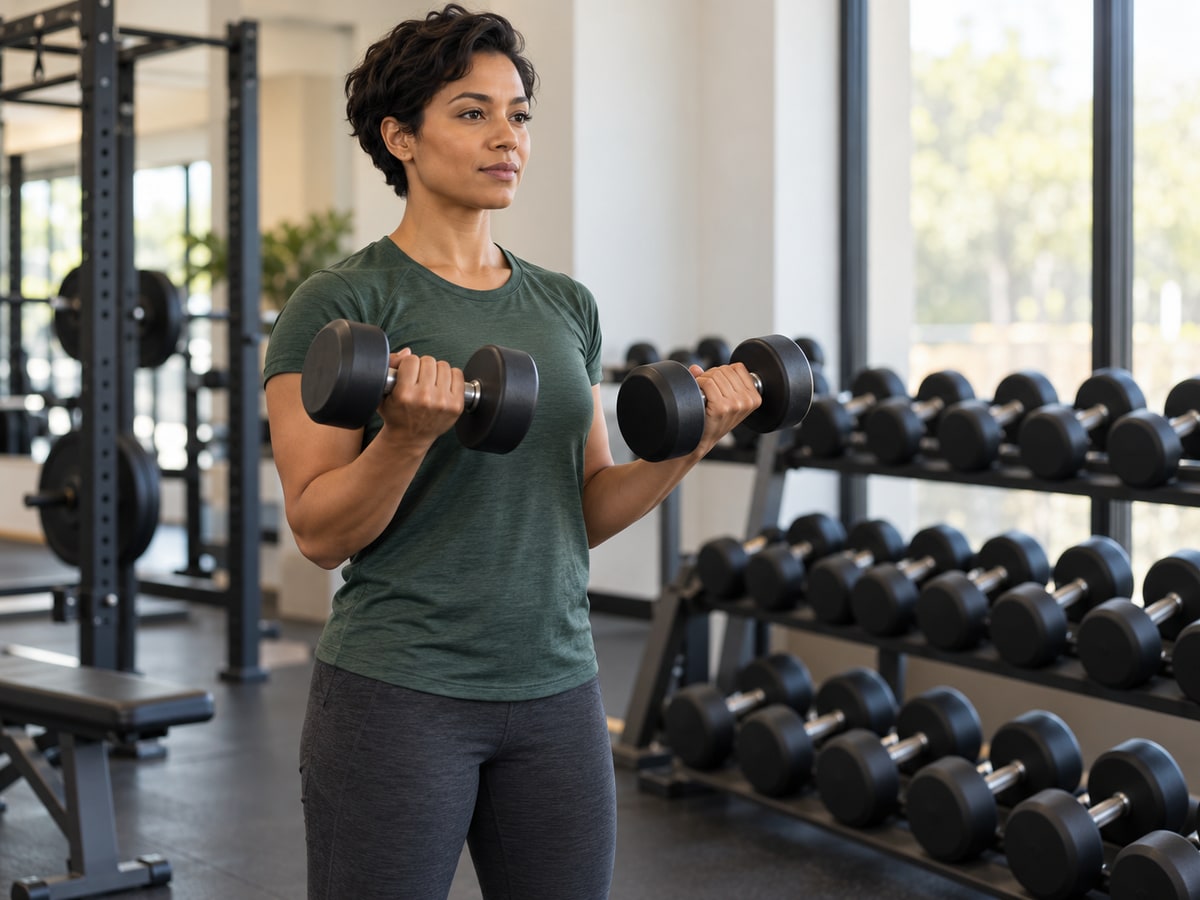
If the next dumbbell is too heavy for the repetitions and technique in your plan, you do not have to force the jump. A practical option is to keep the current weight, work within a repetition range agreed with a qualified trainer, and review whether a smaller equipment step is available.
This guide is for adults who already have a regular strength routine and know their exercise setup. It offers planning suggestions, not a personalised programme or a promise of faster muscle growth. If you are still selecting a starting load, begin with our guide to choosing your first dumbbell weight.
Check what the next step actually means
Look at the number on each dumbbell and check the units. Moving from 8 kg to 10 kg adds 2 kg to each hand, a 25% increase per dumbbell. Moving from 20 lb to 25 lb is also a 25% increase. These are arithmetic examples, not recommended progression targets.
Write the load per hand in your notes so that a pair is not confused with a total. You could record “8 kg each” rather than simply “16”. Check that both dumbbells match before starting. A small-looking gap on a rack can still be a substantial proportion of your current load.
Keep the comparison honest
Before changing anything, compare sessions using the same exercise, equipment, setup and planned rest. If you change the bench angle, shorten the movement or start swinging the weight, put that change in the log rather than treating the extra number as directly comparable.
As a technique reminder, the NHS biceps-curl demonstration uses light weights, arms kept beside the body and a slow lift and lowering. It also advises building repetitions gradually. That is general exercise guidance; it does not establish the right load or repetition target for your particular routine.
When the heavier pair changes the movement
As a conservative suggestion, put the heavier pair down safely if you cannot keep the movement your trainer has taught. Return to an appropriate load or finish that exercise for the day. Avoid repeatedly testing the same unsuccessful jump during the session. Ask for help with setup or technique when needed.
Use a repetition range as a planning tool
Ask your trainer whether adding repetitions at the current load fits your goal. A range gives the plan a lower and upper boundary; it is not an instruction to keep adding repetitions indefinitely. Keep the agreed set count, technique and rest consistent while you use it.
A worked example to discuss with a trainer
Suppose your existing plan calls for two sets in an 8–12 repetition range. Your notes read 10 and 9 repetitions at the same weight. One possible next-session aim is to repeat that performance with the same control, or attempt one additional controlled repetition if appropriate. You do not need to add a repetition to every set or every workout.
After you reach the agreed upper boundary, review the next load with your trainer. Completing the range does not automatically make a large rack jump suitable. If the heavier pair takes you below the plan's lower boundary or changes the movement, reconsider the step instead of forcing the numbers.
What the research can tell you
A 2022 randomised trial by Plotkin and colleagues compared increasing load with increasing repetitions in 43 resistance-trained adults over eight weeks. Participants trained lower-body exercises. The authors found both approaches viable for the adaptations studied, with some differences between outcomes.
That supports discussing repetition progression as one programming option. It does not prove that both approaches are identical, that a particular curl scheme is optimal, or that keeping one weight forever will keep producing results. The study did not test every exercise, equipment gap, age group or long-term training goal.
If the equipment gap remains too large
Ask gym staff whether there is a smaller matching pair or an adjustable dumbbell designed for smaller increments. Use equipment only as intended and follow its locking and loading instructions. As a safety suggestion, avoid taping loose objects to dumbbells or balancing extra weights on them.
A trainer might suggest another exercise or tool with more suitable increments. Treat that as a new baseline. A cable setting and a dumbbell label are not interchangeable records; our gym-equipment backup guide covers choosing and logging a replacement.
Leave one clear instruction for next time
Record the exercise, weight per hand, repetitions in each set and one brief note about control. Then write a single next step: repeat the load, try an agreed extra repetition, or ask about a smaller increment. Our workout-log guide shows the separate details worth keeping.
If pain, dizziness or an unfamiliar symptom occurs, stop and seek appropriate professional advice rather than using a progression rule to push through. Discuss relevant health concerns with your health care professional and a qualified trainer. For planned tools to organise your routines, join the Sweat & Snack app waitlist.