Articles are currently available in English.
Recipe
Peanut-Lemon Poha for One: A Warm Savoury Snack
By Sweat & Snack Editorial Team · 2026-10-17
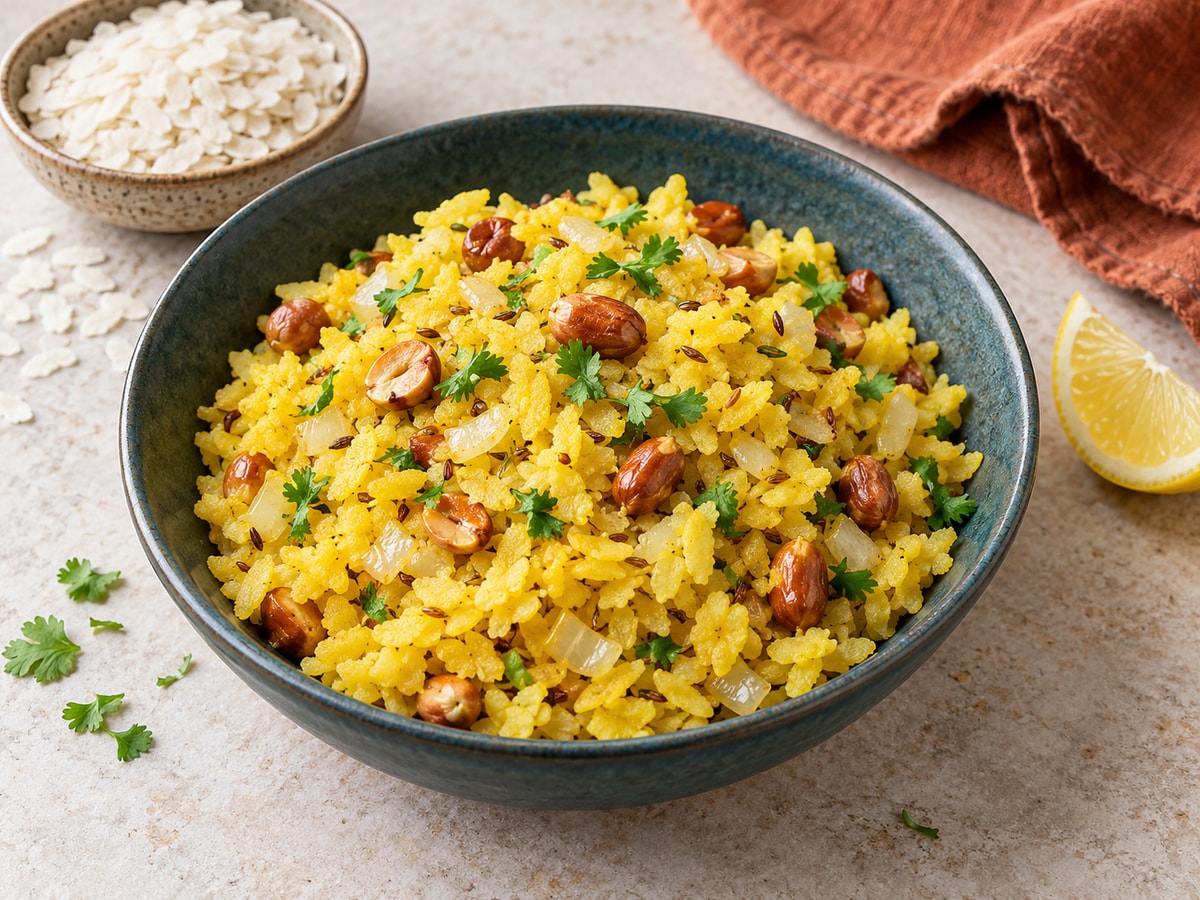
Want something warm and savoury after getting home, without making a full pan for the family? This peanut-lemon poha uses 50 g of thick flattened rice, a little onion and ready-roasted peanuts. Rinse, drain, soften the onion, then gently steam the flakes and finish with lemon.
It is a small-pan cooking suggestion for one person, including an after-workout evening when you feel like a savoury snack. The amount is a starting recipe yield, not a prescribed portion or a recovery target. The texture checks below matter more than a rigid timer.
What you need for one bowl
Yield: one modest bowl. Equipment: kitchen scale, sieve, small frying pan with a lid, spoon and chopping board. Allow roughly 15–20 minutes as a planning estimate; your flakes and hob may need longer.
- 50 g thick poha, also sold as thick flattened rice or thick aval
- 15 g unsalted ready-roasted peanuts, whole or roughly broken
- 40 g onion, finely chopped
- 1 teaspoon neutral cooking oil
- 1/4 teaspoon cumin seeds
- 1/8 teaspoon ground turmeric
- 1–2 teaspoons lemon juice, to taste, plus an optional wedge
- 1 tablespoon chopped fresh coriander, optional
- A small pinch of salt, optional
- Drinking-quality water for rinsing, plus a few teaspoons if needed
Choose the thick flakes for this version and follow any preparation directions on your packet. It is written for plain poha and ready-roasted peanuts, not a seasoned instant mix. Check ingredients before using either product. Wash the lemon and coriander before preparing them, following the Food Standards Agency's produce-washing guidance.
Make the poha, step by step
- Rinse and drain. Put the poha in a sieve and rinse briefly with cool water, turning it gently so the flakes become evenly wet. Drain well and leave it while you prepare the onion. Avoid leaving it submerged unless your packet specifically directs this.
- Check a flake. Press one gently between clean fingers. Aim for a softened flake that yields without a hard centre but still keeps its shape. If it feels dry and firm, sprinkle over one teaspoon of water, toss gently and check again after a short rest. Do not keep adding water to flakes that are already soft.
- Soften the onion. Heat the oil over medium-low heat. Add the cumin seeds and stir briefly until fragrant without letting them blacken. Add the onion and cook, stirring, until softened, roughly 4–6 minutes. Lower the heat if it catches.
- Season and steam. Stir in the turmeric and optional salt, then add the drained poha. Fold gently to distribute the colour. If the pan looks dry and the flakes are still firm, sprinkle in another teaspoon of water. Cover over low heat for roughly 2–3 minutes, then check: the flakes should be soft and hot throughout. Continue gently if needed.
- Finish off the heat. Fold in the ready-roasted peanuts. Add one teaspoon of lemon juice and the optional coriander. Taste and add the remaining lemon only if wanted. Spoon into a bowl and serve promptly.
Keep the heat gentle and use a folding motion rather than repeatedly pressing the flakes against the pan. The goal is separate, soft flakes with peanuts scattered through them, rather than a mash.
Too wet, too dry or sticking?
If the flakes are wet and clumped
Pause before adding any more water. Let the rinsed poha drain thoroughly. In the pan, uncover briefly over low heat and fold gently. This may improve the texture, but it cannot always restore flakes that have already broken down. For your next bowl, shorten the rinse and add extra water in teaspoons only after checking.
If the centre still feels hard
Add a teaspoon of water around the pan, cover and allow another short spell of gentle steaming. Check again before adding more. Different packets behave differently; record the adjustment that worked for yours rather than treating one rinse time as universal.
If the bottom catches
Reduce the heat. If there is a burnt layer, lift the unburnt food into a clean pan without scraping it through the bowl. For a future attempt, use a smaller burner and check the poha earlier.
Swaps and serving suggestions
No peanuts? Leave them out and add extra coriander and lemon to taste. That changes the recipe's nutrition as well as its crunch. When cooking for someone with an allergy, use ingredients and equipment suitable for that person's needs; a swap alone is not an allergen-free guarantee.
No onion? Omit it and start the drained poha after briefly warming the cumin and turmeric in oil. Watch the heat closely. No coriander? The lemon-only finish is fine. These are flavour suggestions, not nutritionally equivalent substitutions.
For a different savoury snack on another day, try the pea-and-oat pancakes, which use a batter and a different cooking method. If dinner is nearly ready, our snack-or-dinner guide can help you think through that situation. You do not need to add this bowl simply because you exercised.
Nutrition context without invented totals
Peanuts are included in USDA MyPlate's Protein Foods Group. That food-group classification does not establish a protein target or exact protein content for this bowl. This recipe has no laboratory analysis or calculated nutrition panel, so it makes no high-protein or guaranteed recovery claim.
If you need an estimate, use the nutrition information on your actual poha and peanut packets and include the measured oil and other ingredients. Keep dry ingredient weights separate from the finished bowl's weight. Our dry-versus-cooked weight guide explains that recording principle using lentils; it is not a conversion table for poha.
Cool and store leftovers with care
The simplest plan is to make this small amount and eat it freshly cooked. If you have leftovers, a conservative approach for this rice-based dish is to follow the FSA's cooked-rice guidance: transfer to a small container, cool quickly and refrigerate ideally within one hour. Use within 24 hours. Reheat only once, until steaming hot throughout, and eat immediately. Do not leave it cooling in the pan.
Keep the fridge at or below 4°C (40°F), as advised by the FDA. Cooked poha is not a shelf-stable gym-bag snack. For a journey without reliable chilling, see our separate no-fridge packing guide.
Sources and scope
- Food Standards Agency: home food fact checker — produce washing and cooked-rice cooling, storage and reheating.
- FDA: safe food storage — refrigerator temperature.
- USDA MyPlate: peanuts in the Protein Foods Group.
Sources checked 17 October 2026. Ingredient amounts, cooking adjustments and serving ideas are practical suggestions. Timings are approximate; this recipe does not claim a kitchen test, medical benefit or guaranteed exercise outcome.