Articles are currently available in English.
Exercise
Same Colour, Different Band? Check Before You Swap
By Sweat & Snack · 2026-10-23
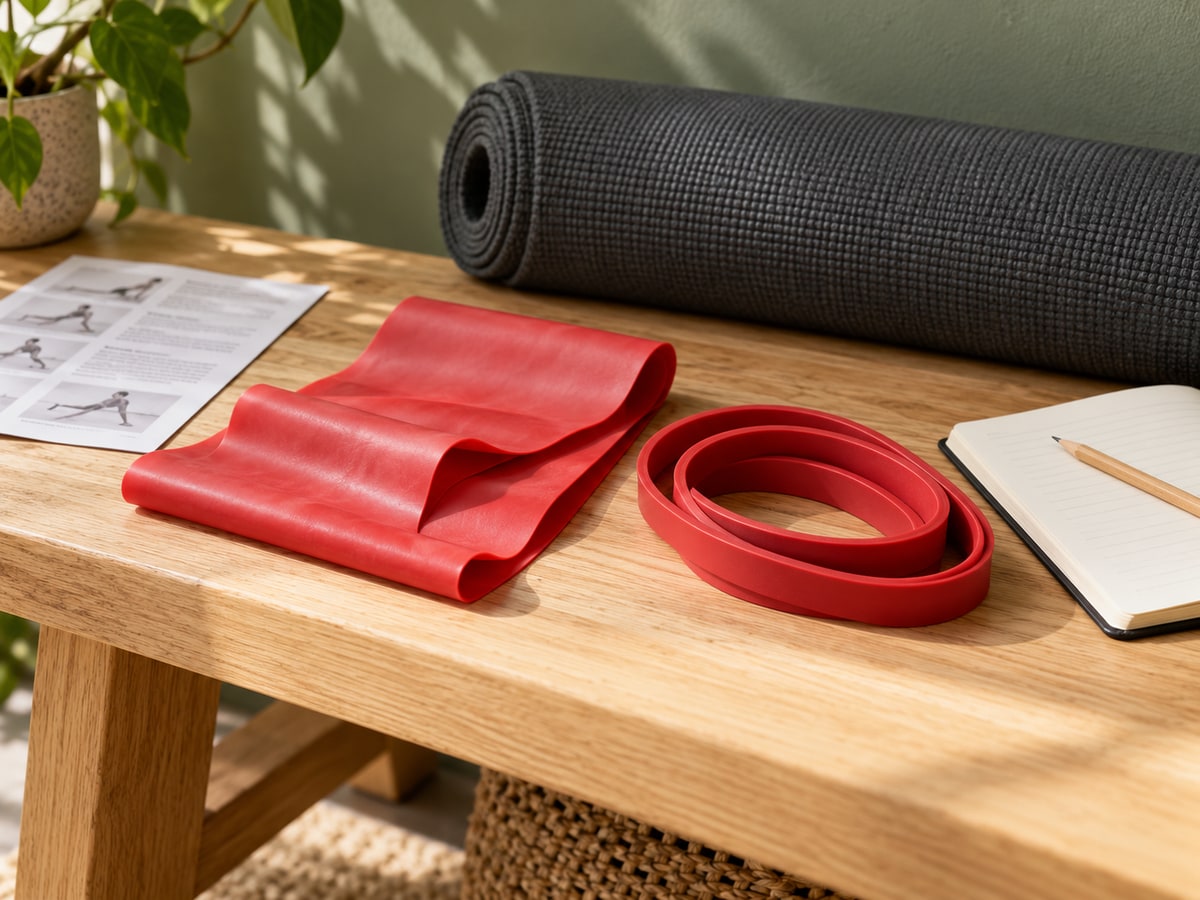
A red resistance band from a new brand is not automatically the same resistance as your usual red band. Check the manufacturer and exact product range first. Then use the instructions for that model to set up the exercise and establish a fresh starting point, rather than copying your previous band selection by colour.
This guide is for people who already use bands and are replacing one, borrowing equipment or taking a familiar routine to a different gym. The checklist and logging examples are practical suggestions, not a personalised exercise prescription or a laboratory comparison of products.
Colour identifies a product system, not a universal load
Decathlon's own band-selection guide explains that manufacturers do not share a universal colour code. Treat a colour chart as information about the named range it accompanies, rather than a rule for every band in the room.
Our suggestion is to identify the product before interpreting its colour. Write down the brand, range, model and whether it is an open flat band, a closed loop or tubing with handles. If you cannot identify borrowed equipment, ask the owner or gym staff for its instructions. A confident guess about the colour is still a guess.
Read the number with its measurement conditions
Look for the manufacturer's explanation of any resistance number or range, including how far the band is stretched when measured. If the packaging gives a number without explaining the conditions, treat the comparison as incomplete. Ask the manufacturer instead of inventing a conversion.
Performance Health explains for THERABAND bands and tubing that force depends on elongation and increases as the product stretches. Its examples compare equal percentage elongation. That product explanation does not establish a conversion between every band brand and a fixed dumbbell weight.
For your own notes, keep the printed number exactly as labelled and add the model. Do not turn a resistance range into a single supposedly exact kilogram load for an entire repetition. If the measurement basis is unavailable, record it as unknown.
A replacement-band checklist
Identify and inspect
Find the instructions for the actual product and its permitted exercise setups. THERABAND's manufacturer recommends checking for tears, abrasions and cracks before use, including connection points, and replacing worn equipment. It also recommends protective eyewear for its band kits. Follow the safety instructions supplied with your own product; do not treat this checklist as a replacement for them.
Rebuild one familiar setup
As a practical suggestion, choose an exercise you already know and use only a setup approved in that band's instructions. Record where you stand, how you hold the band and which approved attachment you use, if any. Ask a qualified instructor to check anything unfamiliar. Do not improvise a door anchor or exceed the product's stated stretch limits to copy another band's feel.
Start a new comparison entry
Keep the previous entry, but give the replacement a separate line. Avoid treating the first session as a test to prove that the new band matches the old one. If the familiar movement cannot be performed comfortably and under control, stop and ask for help adjusting the setup or selection. Pain is not a useful matching method.
What to write in the workout log
Try this compact format: exercise; brand and model; printed resistance; colour; setup; repetitions completed; and a short note about control. It adds equipment identity to our workout-log guide, so a future entry can refer to the same band and arrangement.
For example: “Familiar band exercise; brand B, long loop model; red; manufacturer's labelled range noted; setup checked with instructor; repetitions recorded; new baseline.” This is a documentation example, not an instruction to perform a specific exercise, resistance or number of repetitions.
For experienced users, add a photograph of your approved setup to your private training notes if helpful. Keep camera position and written measurements consistent enough to understand later. A setup photograph documents an arrangement; it does not measure force.
When the replacement still feels different
Do not erase the difference by renaming the new band “equivalent.” Keep separate records and adjust future plans with an instructor where needed. The same planning principle appears in our gym-machine backup guide: equipment changes deserve a fresh check. For a separate fixed-weight problem, see planning around a dumbbell weight jump.
Before your next session, aim to answer three practical questions: Which exact band am I using? Which instructions govern this setup? What entry will let me repeat it? For planned tools to organise equipment notes and training preferences, join the Sweat & Snack app waitlist.