Articles are currently available in English.
Exercise
Treadmill Incline: Percent, Degrees or Just a Level?
By Sweat & Snack · 2026-10-24
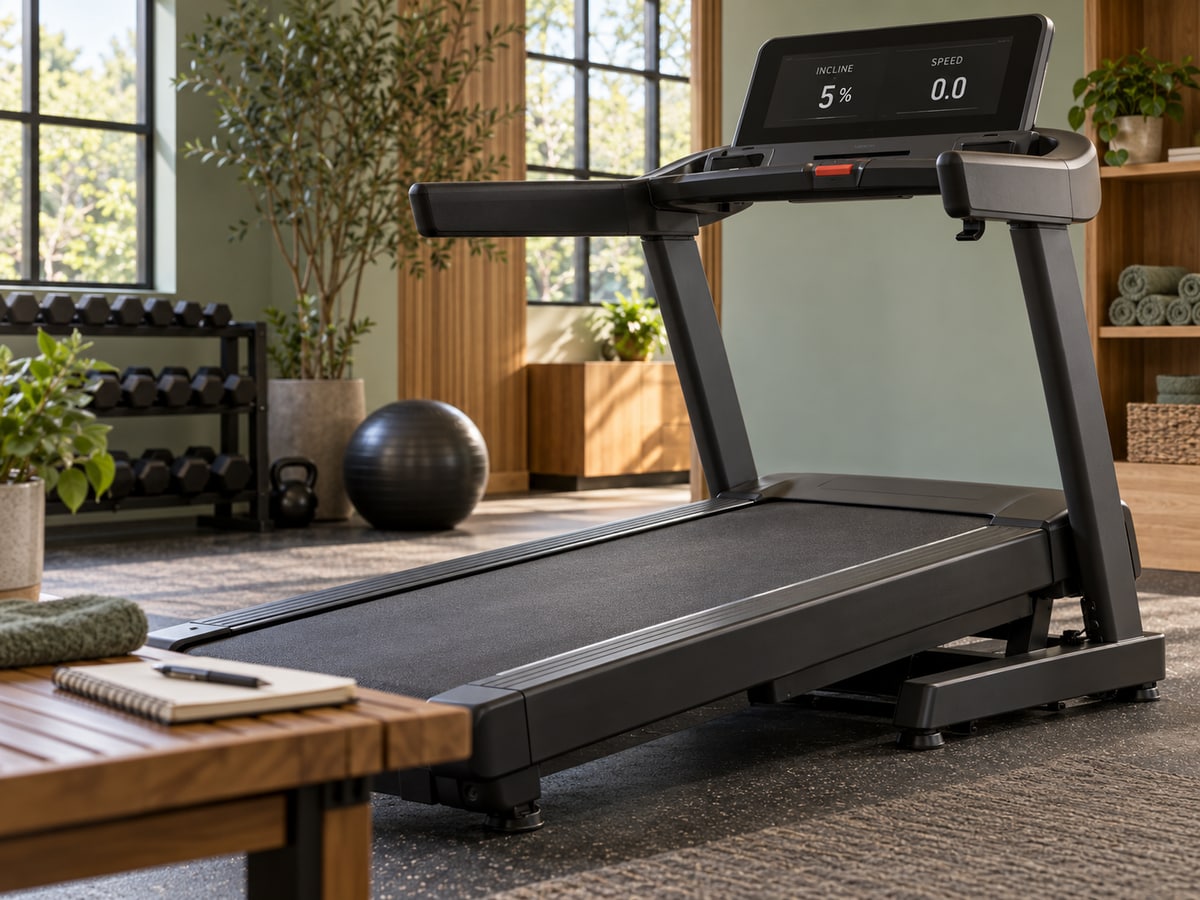
Check the unit before copying the incline number. A setting of 5% describes a grade, 5 degrees describes an angle, and level 5 needs the exact machine's explanation. They are not automatically interchangeable. If the console only says "incline 5", ask the gym staff or check that model's manual before treating it as a percentage.
This is an equipment-reading guide for everyday treadmill users, not a prescribed hill workout. The checks and notebook examples below are suggestions for organising a session. They do not establish the right incline, speed or duration for your body.
Percent grade: rise compared with horizontal distance
Horizon Fitness explains treadmill grade as the vertical height gained for every 100 units of horizontal distance. For example, a 5% grade means a rise of five units for 100 units horizontally. The units can be metres or feet, provided both measurements use the same unit.
That describes the slope's geometry. It does not mean you should put an object under a treadmill to recreate it. Use only the adjustment method and operating instructions supplied for the specific machine.
Degrees measure an angle instead
An angle and a percentage can describe the same slope using different numbers. The mathematical relationship is angle in degrees = arctan(grade divided by 100). Using that calculation, a 5% grade is approximately 2.9 degrees, and a 10% grade is approximately 5.7 degrees. Conversely, 5 degrees is about an 8.7% grade.
These are rounded geometric conversions, not workout recommendations or measurements of a particular treadmill. We calculated them from the formula; we did not test or calibrate your machine. The manufacturer's UREVO incline explainer also distinguishes percentage from degrees. A product listing quoting an angle needs careful reading before comparison with a console quoting percent.
A level needs the model's own explanation
UREVO notes that some machines use incline levels instead of percentages. Do not assume level 3 means 3%. Treat the level as a named setting until the manufacturer's instructions explain what it represents. A workout video's number cannot resolve a missing unit on your console.
Our practical suggestion is to note the brand and model before looking up the manual. If you are in a gym, ask: "Does this incline display show percent grade, or is it a model-specific level?" That is more useful than asking whether the machine can do someone else's number.
Use a short check before the belt starts
Read the label beside the number
Look for a percent sign, degree symbol or the word level. Then read the manual's display section. An unlabeled digit is incomplete information. If the explanation remains unclear, ask staff for an orientation rather than experimenting with an unfamiliar control while walking.
Keep speed separate from incline
Record speed with its unit too. A familiar-looking speed number can have a different meaning on a different machine; our km/h versus mph guide covers that separate check. Confirming one unit does not automatically confirm the other.
Check how this machine is adjusted
Use its own instructions for starting, stopping and changing incline. If adjustment involves a manual deck position, follow the manufacturer's procedure; do not improvise a ramp or adjust hardware while using the belt. This guide cannot replace the operating manual or a staff demonstration.
Make a record you can actually reuse
Instead of writing "incline 5", try a fuller note: "Gym treadmill A, model recorded; incline 5%, speed recorded in km/h; duration noted; session felt manageable." This is a fictional record illustrating what to write, not a suggested starting setting.
If tomorrow's machine says only level 5, keep that label intact and establish a fresh record with help from its instructions or staff. Do not relabel it 5% for a tidier spreadsheet. For a broader logging approach, see what to write in a workout log.
What this check cannot tell you
A known grade is not a personal training plan. It does not establish equivalent calories, comfort or training effects between people, or make indoor walking identical to an outdoor hill. Our outdoor uphill walking guide addresses a different situation: responding to a changing route rather than decoding a console.
If you need help choosing a session, ask a qualified exercise professional who can account for your experience and circumstances. Stop and seek help if you feel unwell. For your next ordinary gym visit, the useful first step is simply to identify the machine, read the unit and keep that unit beside the number.